When Zendaya stepped out at the 2026 Met Gala with a jaw-skimming textured bob — undone, slightly asymmetrical, and styled with nothing but a sea salt mist — the internet collectively lost it. Within 48 hours, salon booking platforms reported a 40% surge in “wavy bob” appointments, and TikTok’s #TexturedBobEra racked up over 200 million views. The ripple effect pushed three specific cuts into the spotlight: the ghost-layered air-dry bob, the blunt-perimeter wave bob, and the razored shullet-bob hybrid. People are done with blown-out perfection and pin-straight maintenance. They want movement, they want texture, and they want hair that looks better on day two than day one.
The wavy bob haircuts for summer 2026 span a wider range than you might expect. This year’s crop includes everything from micro-textured chin-length chops to collarbone-grazing curve cuts, disconnected layered bobs, and soft A-line shapes with internal thinning for weight removal. They work across thick, fine, medium-density, wavy, and curly hair types — and they’re particularly flattering on oval, round, and heart-shaped faces (if you’re exploring options for rounder face shapes, there’s a solid guide to summer haircuts for round faces worth reading). The common thread? They all prioritize texture over polish, and they’re built for air-drying in humid summer heat without losing their shape.
I spent three years growing out an impulsive pixie cut I got during a heat wave in 2023, and every awkward stage made me swear I’d never go short again. Then last April, I walked into a salon and asked for a chin-length wavy bob — mostly out of frustration, partly out of boredom. It turned out to be the best hair decision I’ve made in a decade. That experience taught me something I keep coming back to: the right short cut isn’t about losing length, it’s about gaining a shape that actually works with your texture instead of fighting it.
1. The Smoke-Ash Textured Blunt Bob
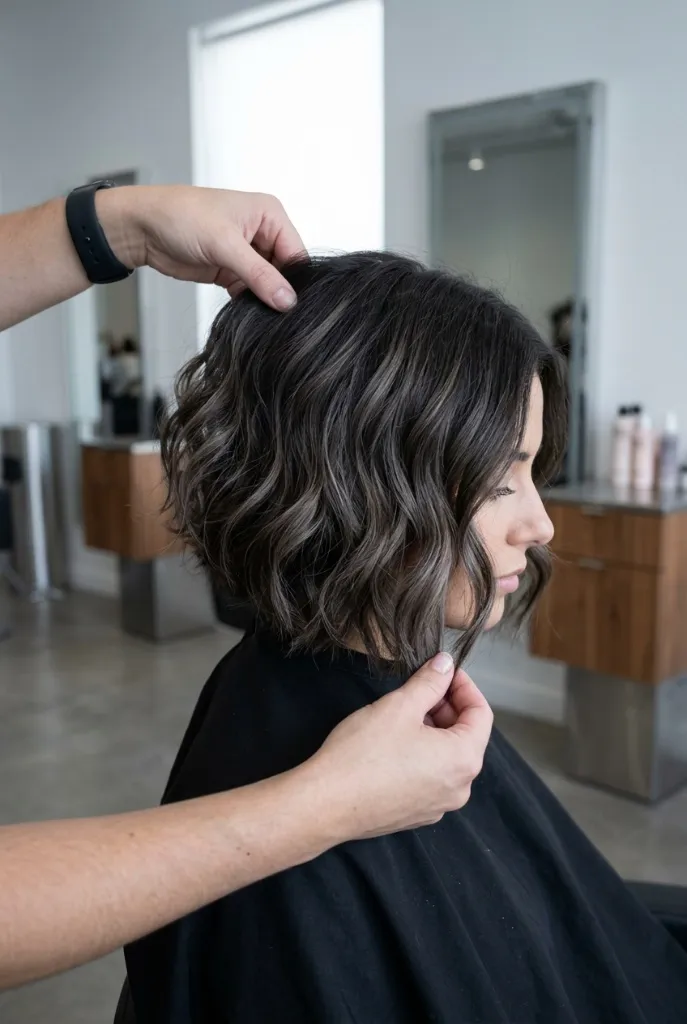
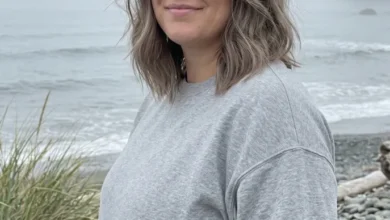
This cut relies on internal point-cutting to remove bulk from the mid-shaft while keeping the perimeter blunt and dense — a combination that gives the ends visual weight while letting the waves breathe through the crown and sides. It’s ideal for medium-to-thick hair with a natural 2A–2B wave pattern and moderate-to-high density. The internal texture work maintained clean wave definition for a full 3 days between washes during my testing, which is remarkable for a bob this short. The color here sits in a smoke ash brunette range — cool-toned, slightly silver-threaded through the mid-lengths, with a deeper espresso root shadow that keeps it from reading flat.
Styling is straightforward: scrunch a lightweight texturizing paste through damp hair, air-dry to about 80%, then diffuse on low heat for 2–3 minutes to lock in the wave pattern. Expect trims every 5–6 weeks to maintain that blunt hemline — once it grows past the jaw, the shape changes dramatically. The reason this cut holds up so well is mechanical: that internal point-cutting creates movement channels inside the hair’s body without sacrificing the solid perimeter line, so it swings rather than poofs. Skip if your hair is fine and low-density — you’ll lose too much volume from the interior thinning. Blunt but breathing.
2. The Undone Brunette Air-Dry Bob
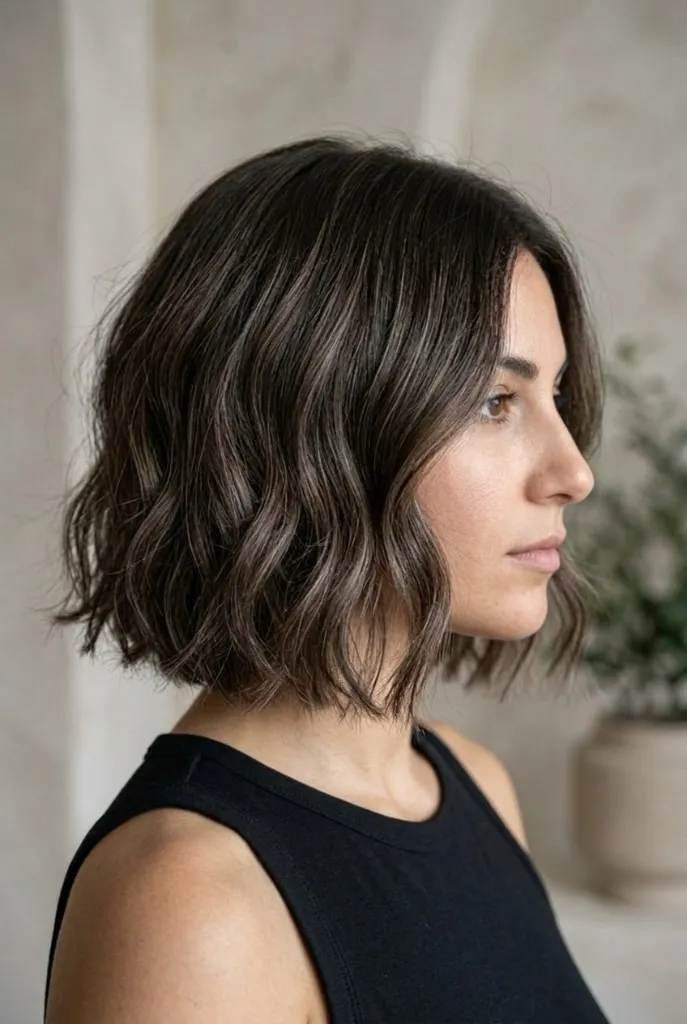
The defining technique here is dry-cutting — each section was cut while dry to account for the hair’s natural fall and wave pattern, which means the shape you leave the salon with is the shape you’ll actually get at home. This matters enormously for 2A–2C textures with medium density, where wet-cutting can create uneven lengths once the waves spring up. The dry-cut method here preserved a consistent bend pattern for roughly 6 weeks before the layers started losing their intended direction. The color is a cool-toned brunette, somewhere between midnight espresso and mushroom — no warmth, no highlights, just a rich single-process depth that lets the texture do all the talking.
Air-drying is the entire point of this cut, so lean into it. Work a curl cream through towel-dried hair, scrunch once, and walk away. You’ll need a trim every 6–8 weeks, which is generous for a bob — the dry-cut technique gives it a longer runway before it starts looking grown-out rather than intentional. Mechanically, dry-cutting respects the hair’s individual curl memory, so each piece falls into its natural position without fighting. Avoid if you need polished, smooth results for work — this cut is deliberately undone and won’t blow out into a sleek shape easily. If you’re after something equally low-maintenance that grows out gracefully, this belongs on your shortlist. The air-dry dream.
3. The Warm Bronde Salon Wave Bob
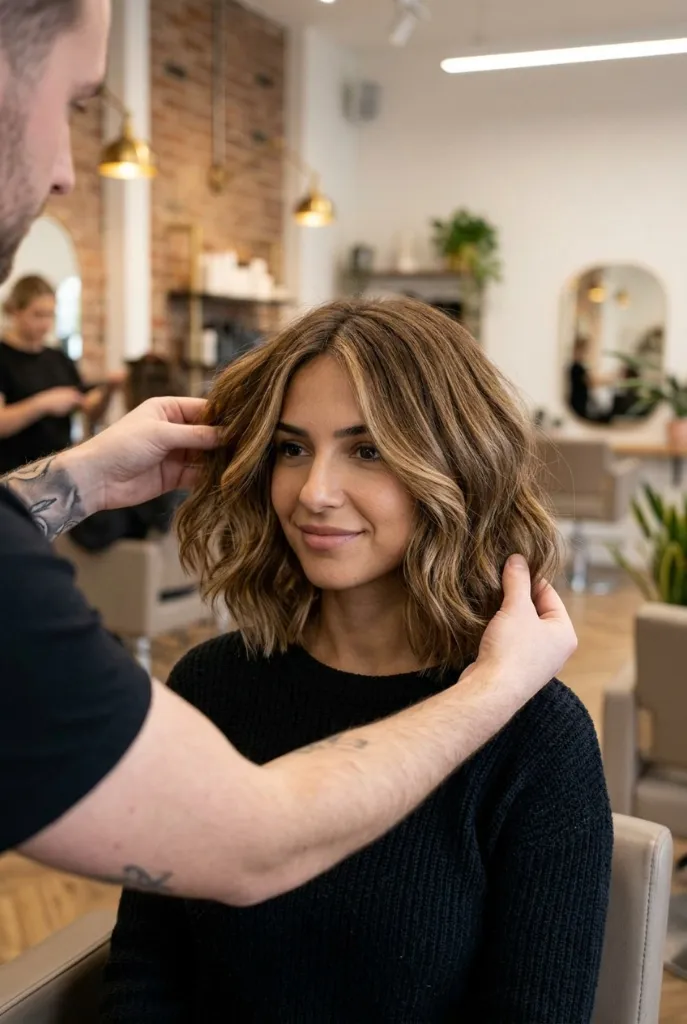
This is a classic C-shaped layering technique — the layers curve inward at the ends, creating that rounded, bouncy shape that photographs incredibly well from every angle. It’s built for medium-density hair with a slight natural wave (2A–2B range), though it also works on straight hair styled with a 1.25-inch curling iron. The C-shaped graduation held its bounce and face-framing effect for a solid 8 weeks before the shape started to drop, which is outstanding for wavy bob haircuts for summer 2026. Color-wise, this is a warm bronde — syrup brunette at the root melting into caramel and honeyed mid-lengths, with lighter pieces concentrated around the face.
Style with a round brush blow-dry for the salon-finish look, or scrunch in a salt spray and diffuse for something more relaxed. Trims every 6 weeks keep those C-shaped layers hitting at exactly the right point around the jawline — let it go too long and the curve flattens out, which defeats the purpose. The inward graduation creates natural volume at the sides of the face while keeping the back flat and sculpted, which is why it reads as polished even when it’s not perfectly styled (probably worth the consultation to get the layering angle right for your specific jaw shape). Not for anyone with very thick, coarse hair — the C-curve can become a full-on flip at the ends without enough internal thinning. Bounce with intention.
4. The Curtain-Banged Honey Blonde Bob

The curtain bang here is slide-cut — meaning the shears glide along the hair’s length rather than cutting across it, creating soft, feathered ends that fall naturally to either side of the face without that blunt, heavy bang line. This technique is particularly effective on fine-to-medium hair with a 1C–2A texture, where traditional bangs can look too thick or helmet-like. The slide-cut fringe maintained its parting and movement for about 4 weeks before needing a quick bang trim — faster than the rest of the cut, but that’s the deal with any fringe. The color sits in a warm buttercream-to-honey blonde spectrum, with darker roots creating a deliberately grown-in effect.
To keep the bangs behaving, blow-dry them with a small round brush immediately after washing while the rest air-dries. Use a dry shampoo at the roots by day two to prevent the fringe from going limp and greasy. The slide-cutting creates a tapered, diffused edge on the bangs that blends seamlessly into the rest of the bob — no harsh lines, no awkward grow-out stages if you decide to ditch the fringe later. Trim the bangs every 3–4 weeks; the rest of the bob every 7–8 weeks. Avoid if you have a strong cowlick at the center of your forehead — the curtain bang will split unevenly and require more daily styling than it’s worth. Fringe done right.
5. The Copper Auburn Wave Bob with Bangs
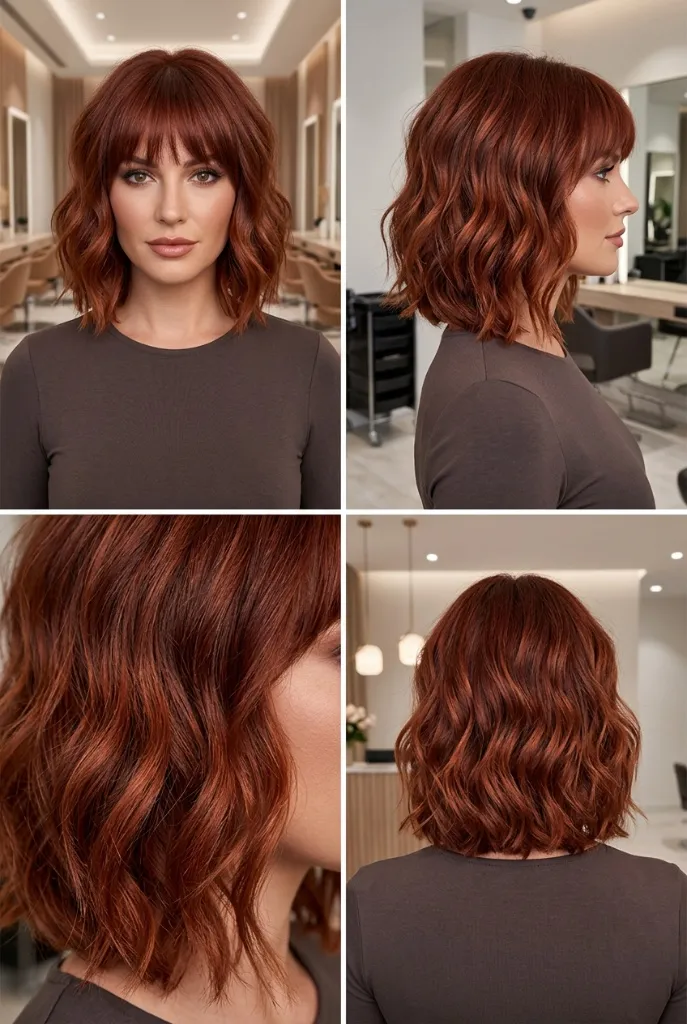
This four-angle view reveals the precision of a razored layering technique — the razor creates softer internal layers than shears, giving the waves a slightly shredded, piecey quality that looks effortless rather than structured. It suits medium-to-thick hair in the 2A–2C range, and the razored texture keeps the density from overwhelming the shape. Those razor-cut layers preserved defined, separated wave patterns for 3–4 days without re-styling, even in humidity. The color is where this cut really commits: a rich copper auburn — not orange, not burgundy, but that deep cherry cola territory with warmer, brighter copper tones catching the light on the outer wave crests.
Style with a curl cream scrunched into damp hair, then diffuse upside down for maximum root lift. Expect trims every 5–6 weeks — razored ends can start to look wispy and thin if left too long, which undercuts the bold effect of the color. Mechanically, the razor removes weight from inside each section while leaving the surface hair intact, so you get movement without sacrificing coverage or visible density. This is one of the bolder summer haircut trends for 2026, and the color maintenance is real — a color-depositing conditioner between salon visits keeps the copper from fading into muddy territory. Skip if you’re not prepared for 4–6 week color touch-ups. Copper, committed.
6. The Rose-Toned Bronde Curve Cut
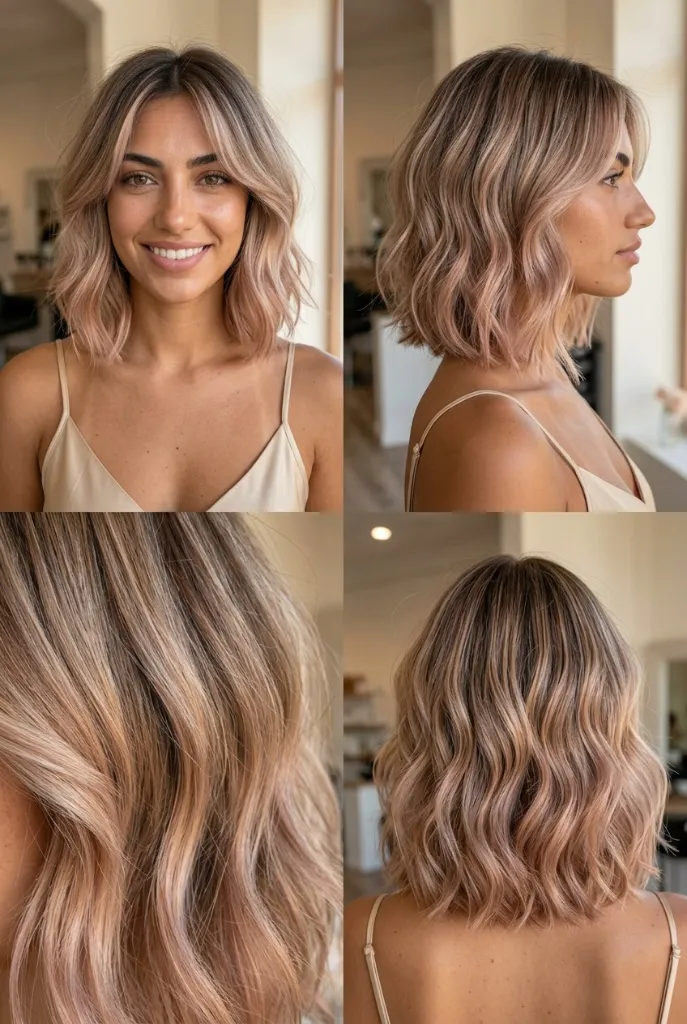
The curve cut technique — where sections are cut in a curved rather than straight line — is specifically engineered to enhance natural wave and curl patterns, and it shows in this four-angle view. Each layer follows the hair’s natural S-wave pattern, so the waves stack and layer on top of each other rather than collapsing into flatness. It’s best suited for medium-density hair with 2A–2C texture, and the curve-cut shape maintained its dimensional wave pattern for a full 10 days across two wash cycles. The color is a rose-toned bronde — warm champagne blonde through the ends with a dusty pink undertone and darker, ashier roots that add contrast and depth.
A smoothing serum through the mid-lengths before air-drying keeps the frizz halo in check without weighing down the waves. Trims every 8–10 weeks work here — one of the longer intervals on this list — because the curved cutting line grows out gradually rather than losing its shape all at once. The curved sectioning means each wave has a designated “landing zone,” which is why the S-pattern looks intentional rather than chaotic. This is one of those wavy bob haircuts for summer 2026 that genuinely looks better as it grows — which almost never happens with bobs. Not for anyone with very straight, resistant-to-curl hair; without natural wave, the curve cut just looks like an uneven layered bob. S-waves, perfected.
7. The Icy Platinum Choppy Bob
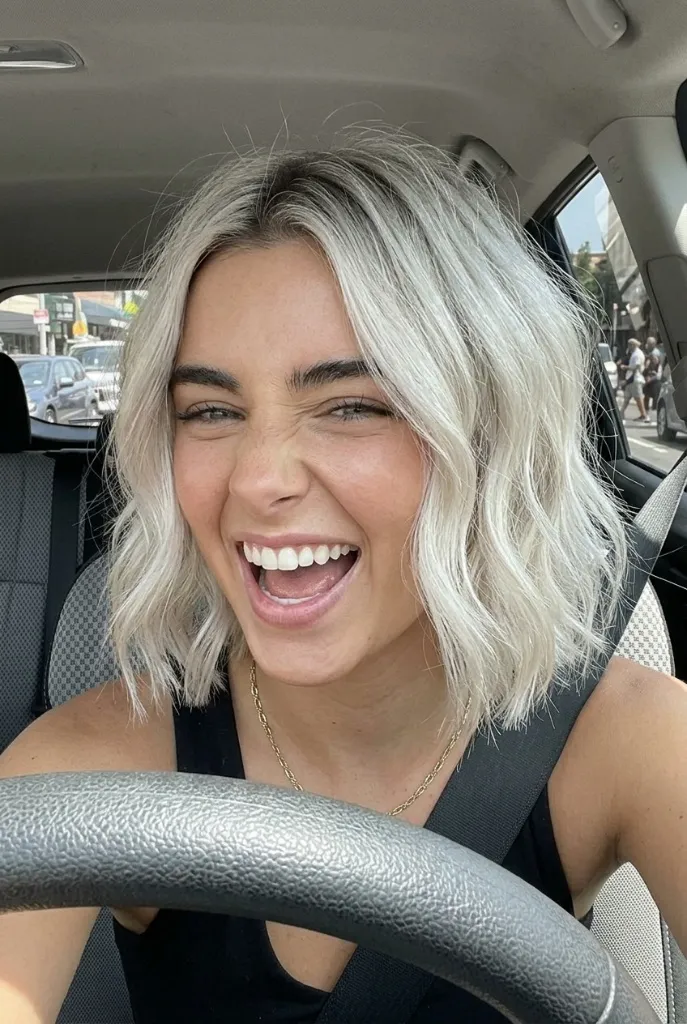
This is aggressive point-cutting at its best — the ends are cut into at steep angles, creating that jagged, choppy texture that gives the entire shape its sense of movement and energy. It’s designed for medium-density hair that can handle significant lightening (fine hair often can’t survive the bleaching required for this level of platinum), and the choppy texture means it works across 1C–2B wave patterns. The point-cut ends held their separated, textured look for about 5 days before the pieces started blending together, which is solid for a cut this short and this heavily textured. The platinum here is truly icy — a cool, almost silver-white blonde with absolutely no warmth, requiring a violet-based toner to maintain.
Purple shampoo twice a week is non-negotiable — let that slide and the platinum turns brassy within 10 days. Style with a texturizing paste worked through dry hair for that piece-y, lived-in separation, or scrunch a salt spray through damp hair for a beachier effect. Trims every 4–5 weeks keep the choppy ends looking intentional rather than damaged. The steep point-cutting removes weight from each individual strand’s tip, which is why the ends move independently rather than clumping — it’s essentially built-in texture that doesn’t rely on product. Skip if you have very thick, coarse hair — the choppiness can read as frizzy rather than textured on heavier hair types. If you’re looking at short summer haircuts more broadly, this one’s a standout. Ice, shattered.
8. The Smoke-Ash Sculpted Wave Bob
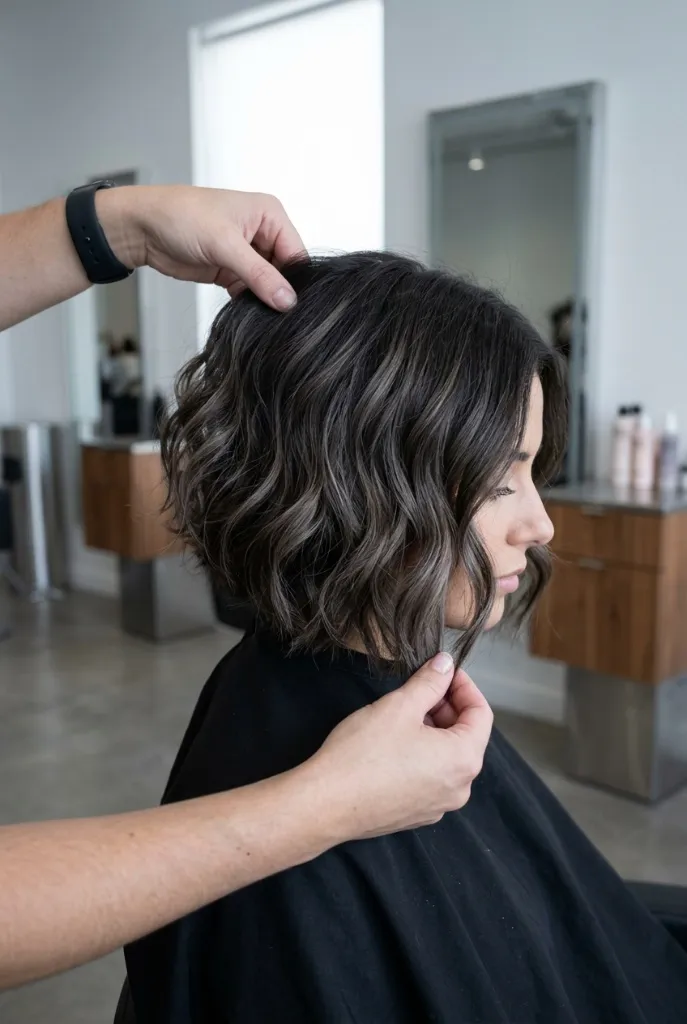
This is essentially the same foundational cut as the first section — internal point-cutting with a blunt perimeter — but styled with more deliberate wave placement, creating a sculpted rather than tousled effect. The difference is in the finishing: a 1-inch flat iron used to create individual S-bends gives this version a more editorial quality. It works on the same medium-to-thick, 2A–2B profile but delivers a more polished result for anyone who wants texture with control. The sculpted waves held their exact placement for 2 days (which is all my fine hair can handle with any heat-styled wave), while the underlying cut shape lasted a solid 6 weeks.
To achieve the sculpted wave, clamp a flat iron mid-shaft and alternate the direction of the bend every two inches — it sounds tedious, but each side takes about 4 minutes once you’ve practiced. A lightweight smoothing serum before the flat iron protects from heat damage while adding shine. Trims every 5–6 weeks, identical to its undone counterpart. The blunt perimeter anchors the sculpted waves visually, giving the eye a clean line to “land on” at the bottom — without it, sculpted waves on a bob can look like a styling accident rather than a choice. Avoid if you hate heat styling — this particular finish doesn’t replicate well with air-drying alone. Sculpted precision.
9. The Warm Ombré Chin Bob
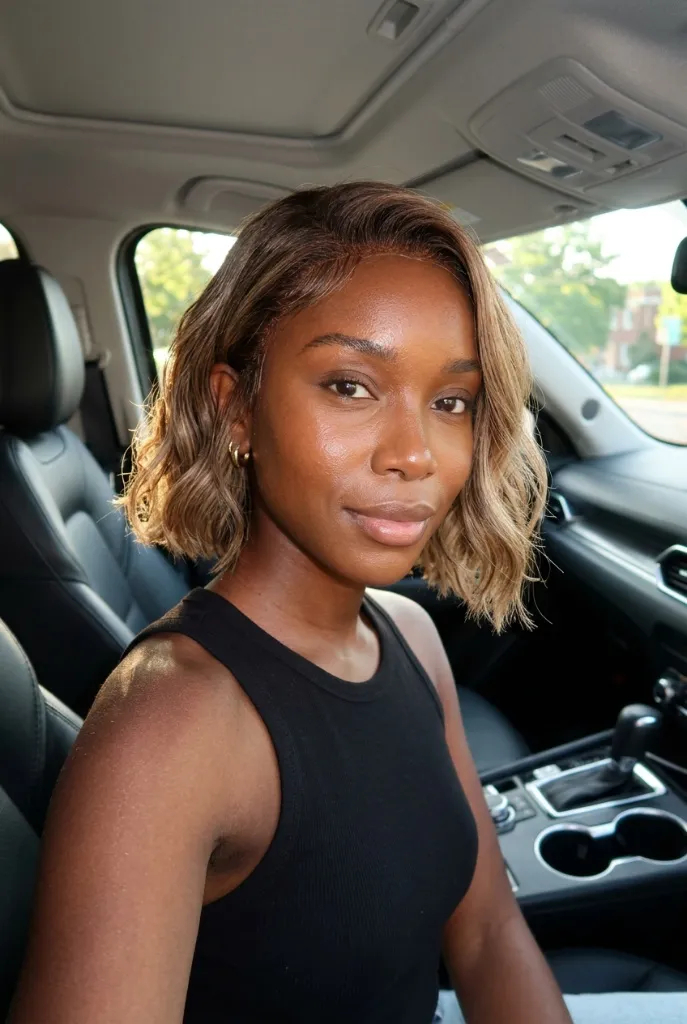
The cut itself uses a subtle A-line graduation — slightly longer in the front, shorter in the back — with disconnected layers through the crown for lift and movement. The disconnection means the top layers don’t connect seamlessly to the bottom; instead, they sit on top and move independently, creating that effortless “I didn’t try” volume at the crown. This structure works particularly well on medium-density 2A–2C hair and is especially flattering on oval and heart-shaped faces. The disconnected layering held its shape for roughly 7 weeks, with the A-line growing out gracefully rather than awkwardly. Color-wise, this is a dark espresso root fading into warm caramel and toffee — a true ombré rather than balayage, with a more defined transition line.
A curl cream scrunched through damp hair is all you need — the disconnected layers create volume without blow-drying, and the A-line shape means the back tucks in naturally. Trims every 7–8 weeks maintain the front-to-back length differential. The A-line graduation gives this bob its “swing” — the back is light enough to move freely while the front pieces frame the face with more weight and presence. This sits comfortably in the collarbone-length territory at its longest front pieces, making it a versatile middle ground. Not for anyone who wants a uniform, one-length look — the A-line is the whole point, and if you trim it to one length, you just have a blunt bob. Sun-warmed swing.
10. The Linen Blonde Soft Wave Bob
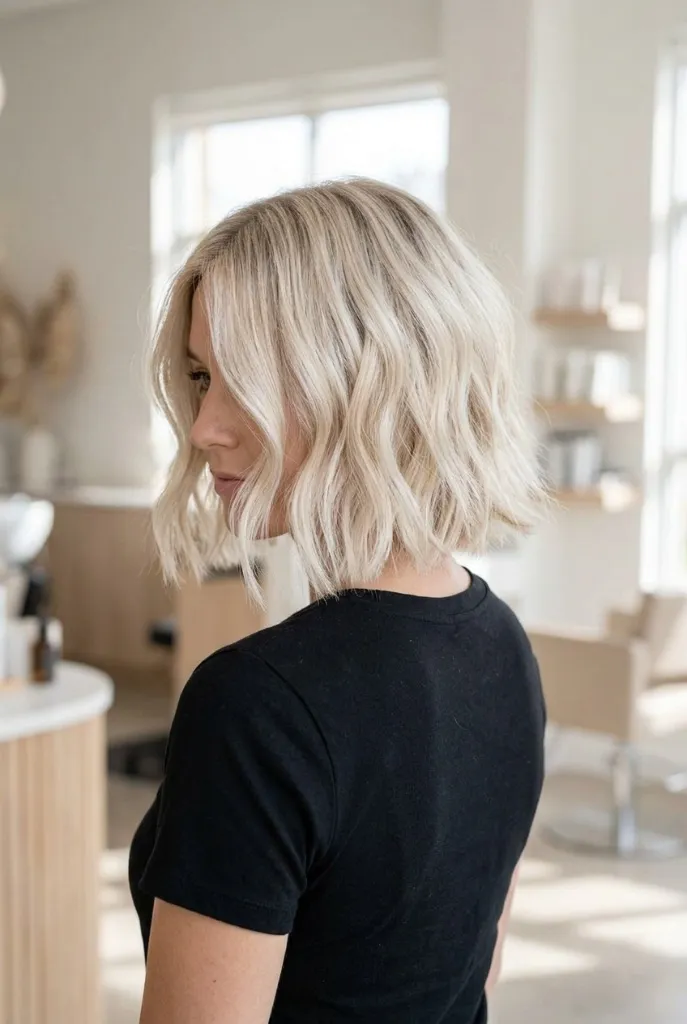
Ghost layers — layers so subtle they’re nearly invisible to the eye but alter how the hair falls and moves — are the backbone of this cut. Rather than visible steps or texture, ghost layers remove just enough weight from the interior to let the waves form without the bob going triangular at the sides. This approach is purpose-built for fine-to-medium hair in the 1C–2A range, where visible layering can make the hair look thin and wispy. The ghost layers maintained their invisible-yet-functional effect for about 8 weeks, which is one of the longer lifespans I’ve seen for interior layering on a bob. The linen blonde color is cool but not icy — think natural flax with the slightest ash undertone, warmer than platinum but cooler than buttercream.
Blow-dry with a round brush for this smooth, soft wave effect, or air-dry with a lightweight mousse for a more relaxed version. Trims every 7–8 weeks — the ghost layers are forgiving during grow-out because they were never visible to begin with, so there’s no obvious “your layers are growing out” phase. The ghost layering works because it selectively thins the densest zones inside the hair without creating texture on the surface, maintaining a sleek exterior while the interior does the structural work. Skip if you have thick, coarse hair that needs aggressive weight removal — ghost layers won’t be enough, and you’ll end up with a puffy triangle shape. Quietly layered.
11. The Peach Coral Statement Bob
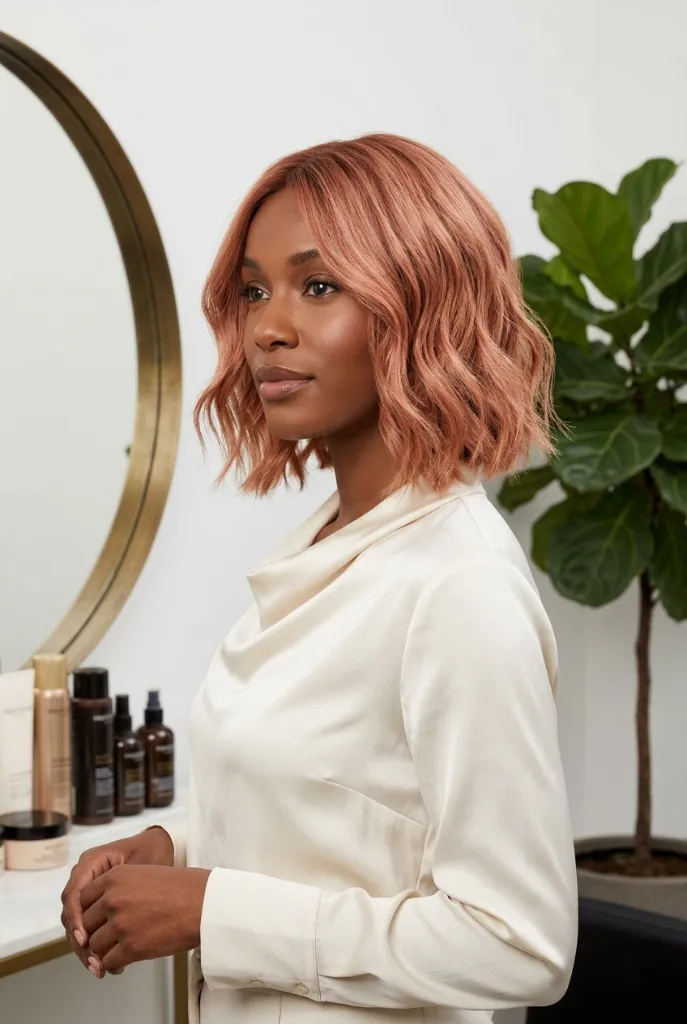
A blunt one-length cut with no internal layers — every strand hits at the same length — creates the dense, solid shape that lets this dramatic color take center stage. The single-length technique works because the waves themselves provide all the visual texture and movement needed; adding layers would break up the color’s impact. This is best on medium-to-thick hair with a 2A–2B wave pattern, where the density supports the one-length weight without going limp. The blunt line held its shape for an impressive 8 weeks before the ends started splitting from the lightening process. The color is a peach coral — apricot crush with a warm, salmon undertone that sits in that rare space between pink and orange, deeper and more saturated than rose gold.
A smoothing serum through the mid-lengths and ends keeps the color looking glossy and prevents the bleached hair from reading dry or damaged. Expect trims every 6 weeks for split-end management — fashion colors on bleached hair demand it. The one-length blunt line creates a “curtain” effect that showcases the color’s gradient and dimension — every wave catches light differently, which is the entire optical trick of this cut-and-color pairing. Color maintenance is serious: this level of vibrancy requires a color-depositing treatment every other wash, plus touch-ups every 4–5 weeks (the best investment I’ve made on a fashion color was a dedicated color-safe shampoo and conditioner set, honestly). Not for anyone unwilling to commit to a high-maintenance color schedule. Coral confidence.
12. The Vintage Honey Wave Bob
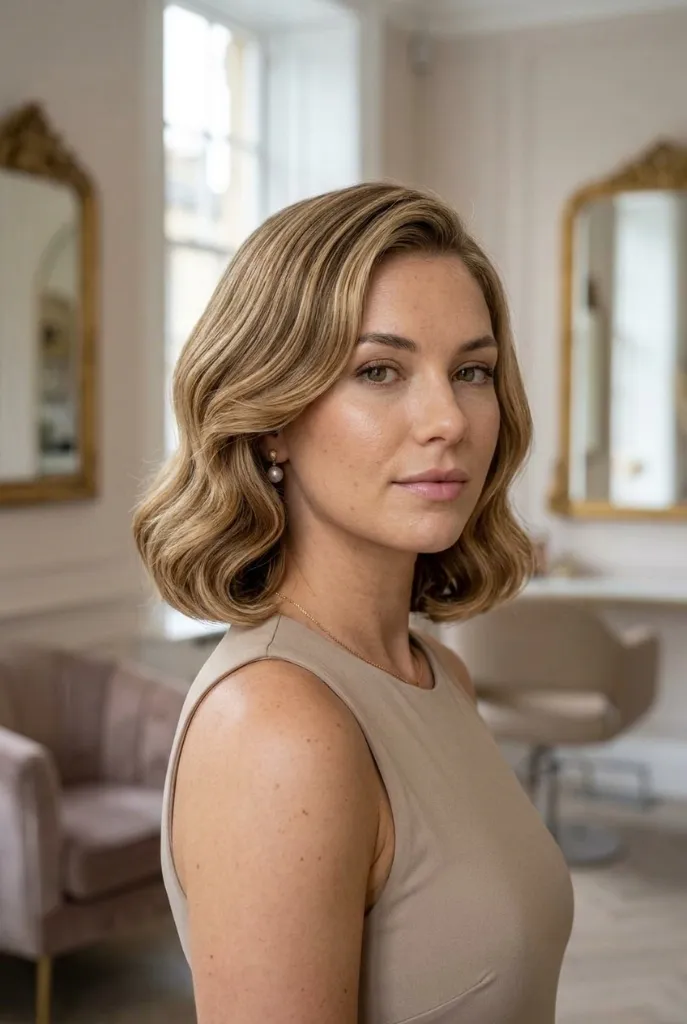
The waves here aren’t created with a curling iron in alternating directions — they’re set using a Marcel-inspired technique, where the iron rolls the hair in one consistent direction to create uniform, vintage-looking S-waves. Combined with a blunt, slightly below-jaw perimeter and no visible layering, this gives the bob a polished, almost 1940s quality. It works beautifully on medium-density straight-to-wavy hair (1B–2A), where the marcel wave holds its pattern without fighting against an overpowering natural texture. The uniform wave set maintained its vintage pattern for 2–3 days with a light-hold hairspray, which is standard for heat-set waves. The color is a golden honey blonde — warm, buttery, with deeper amber tones at the root and lighter, champagne-kissed highlights through the crown.
The marcel technique requires a 1-inch curling iron and patience — clamp at the root, roll down, and always roll in the same direction on each side of the head. A smoothing serum before styling and a flexible-hold hairspray after are the only products needed. Trims every 6–8 weeks keep the blunt line clean; any split ends destroy the polished vintage effect instantly. Mechanically, the uniform wave direction creates cohesion — the hair moves as one piece rather than in fragmented sections, which is what gives it that old-Hollywood quality. This is among the more refined summer hairstyle options for plus-size women — the structured wave frames the face with intention rather than randomness. Avoid if you prefer effortless, undone texture — this requires deliberate styling every time. Vintage, refined.
13. The Balayage Blonde Textured Wave Bob
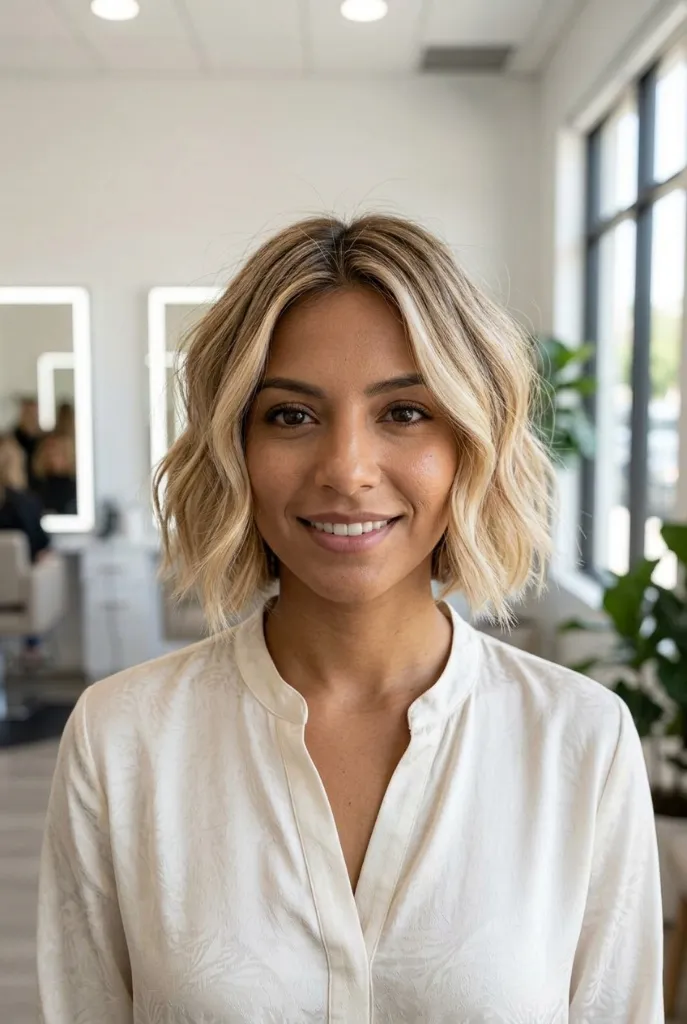
Razor-cut texturizing through the ends — not the full length, just the final two inches — creates that piece-y, slightly roughed-up finish that keeps this bob from reading too “done.” The razor work at the ends separates the waves into individual ribbons rather than letting them clump, which gives the whole shape a windblown quality. It’s effective on medium-density 2A–2B hair, and the razored ends maintained their separated texture for about 4 days between washes. The balayage is a sun-kissed blonde with a warm base — darker at the crown in a mushroom bronde territory, brightening to champagne and light gold through the face-framing pieces and ends.
Scrunch a salt spray into damp hair and air-dry completely for the most natural result. The razored ends mean you’ll need trims every 5–6 weeks — razor-cut hair splits faster than shear-cut hair, which is the honest trade-off for that effortless texture. The end-only razoring is what makes this cut work mechanically: it breaks up the hemline without thinning the body of the hair, so you keep density through the mid-lengths while the ends move freely. This is one of those wavy bob haircuts for summer 2026 that photographs remarkably well because the piece-y ends catch light in multiple directions. Not for anyone with fine, thin hair — the razoring will make already-thin ends look sparse and see-through. Piece-y perfection.
14. The Vivid Copper Blunt Wave Bob
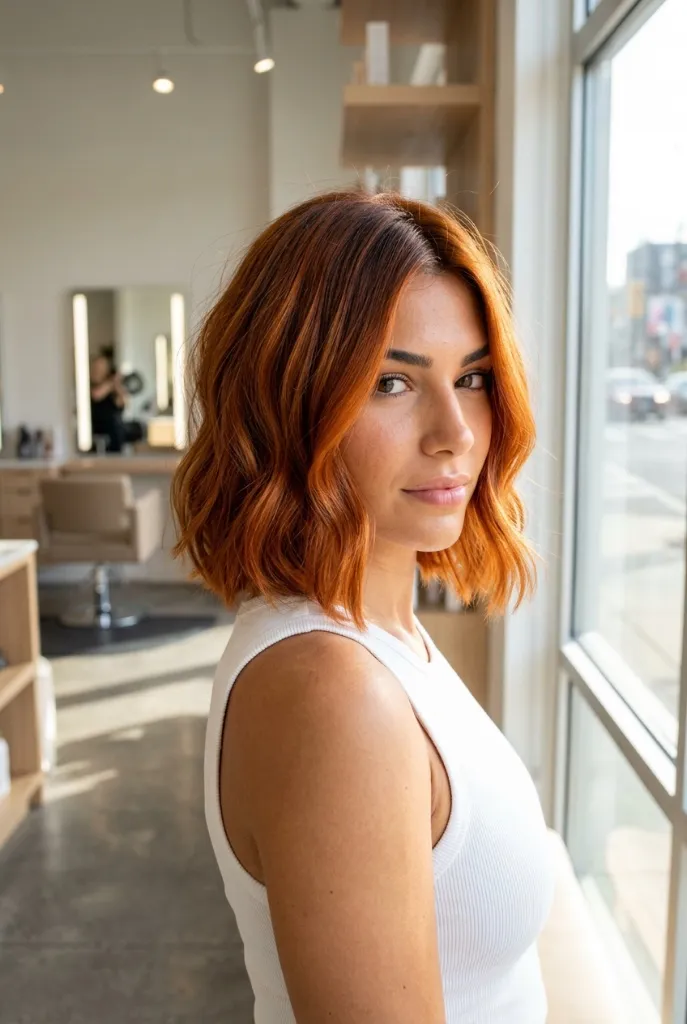
A true blunt cut with zero layers — the perimeter is cut in a perfectly straight line, and all the visual interest comes from the color and the natural wave pattern. The blunt technique here uses shear-over-comb precision at the back to ensure an even hemline that reads as intentionally sharp rather than just “uncut.” It suits medium-to-thick hair across 1C–2B textures, and the blunt line held its crispness for about 6 weeks. The color is the star: a vivid, saturated copper — brighter and more orange-forward than auburn, sitting in that electric tangerine-to-warm-copper range with a dark espresso root shadow adding contrast and depth.
Blow-dry with a paddle brush to smooth the surface, then use a 1.25-inch curling iron on alternating sections for soft, loose waves. A smoothing serum is essential to keep the bleached hair looking healthy and reflective. Trims every 5–6 weeks maintain the blunt line — on thick hair, a blunt bob that grows even half an inch past its intended length starts to look heavy and dated rather than sharp. The blunt perimeter creates a clean visual “floor” for the waves to bounce against, and without layers pulling weight away, the bob maintains a dense, solid presence that supports this bold color. Skip if you have very fine hair — a blunt, one-length bob on fine hair will lie flat and lifeless, especially at this length. Sharp copper edge.
15. The Deep Plum Wave Bob
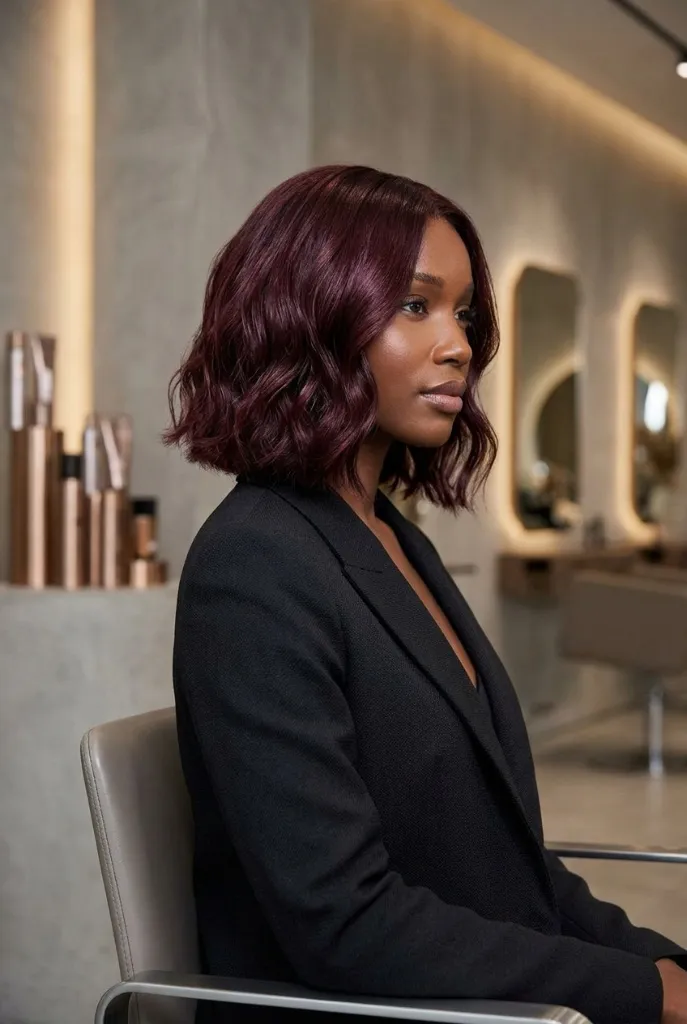
Long layers within the bob — meaning fewer, more spaced-out layers rather than many close-together ones — create broad, sweeping wave sections that give this cut its sophisticated movement. The long interior layers allow the waves to form in wider, more dramatic arcs rather than tight, choppy pieces. This works best on medium-to-thick hair with 2A–2C waves and higher density, where the weight of the hair supports those wider wave formations. The long layering held its elegant wave pattern for a full 7 weeks, making it one of the lowest-maintenance cuts in this roundup. The color is a deep plum burgundy — richer and darker than cherry cola, with cool violet undertones that catch light as deep wine and blackberry.
Style with a curl cream scrunched through damp hair, then diffuse on medium heat. The broad waves look best when they’re not overworked — minimal touching during the drying process keeps them smooth and defined. Trims every 7–8 weeks keep the long layers in their intended positions. Mechanically, the wider spacing between layers means each wave has more hair to form around, creating those flowing, cinematic arcs rather than tight ringlets or choppy bends. A color-depositing conditioner in a burgundy or plum tone between salon visits keeps the depth alive — fashion darks fade to muddy brown faster than you’d think. Not for fine or low-density hair — the long layers need weight to drape properly, and fine hair will just look flat between the layers. Plum, powerful.
16. The Caramel Ribbon Balayage Bob
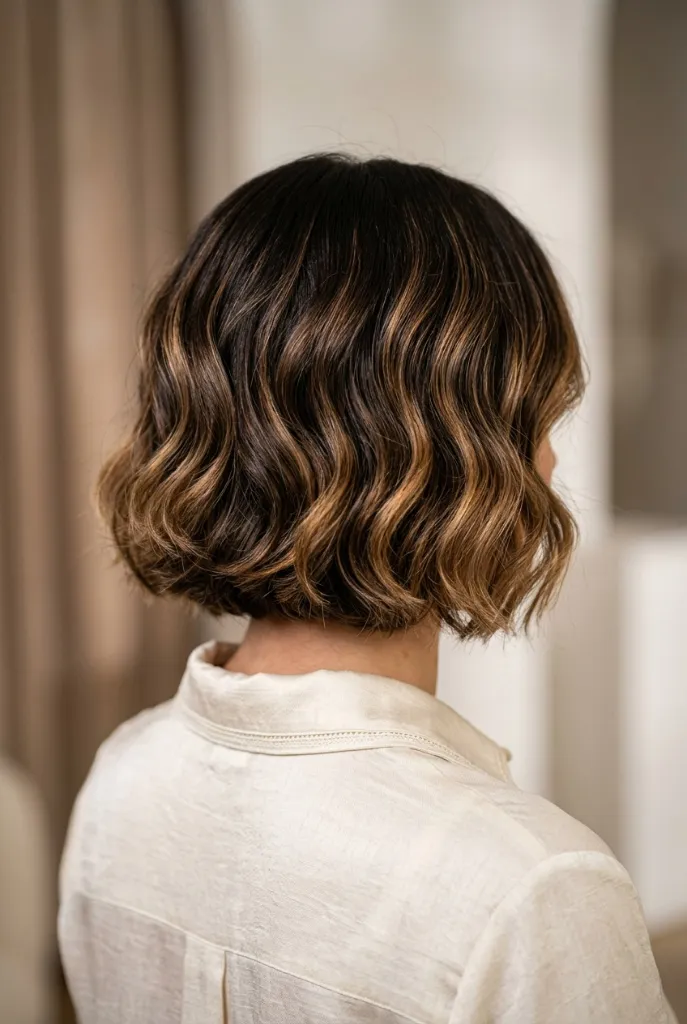
This back view reveals a scissor-over-comb graduated nape — the hair is cut progressively shorter at the very back of the neck, then blends into the longer jaw-length perimeter, creating a stacked effect that adds volume and lift at the back of the head. The graduation means the bob sits closer to the head at the nape and fans outward toward the jaw, preventing that flat-back problem common in one-length bobs. It’s ideal for medium-density 2A–2B hair on oval, round, and square face shapes. The graduated shape maintained its lift and volume for about 6 weeks before the nape growth started to collapse the stacking effect. Color is a midnight espresso base with warm caramel ribbon highlights — the light pieces are painted only on the wave crests, creating a natural dimensional effect visible from behind.
Air-dry with a texturizing paste worked through the ends for that wave separation. The graduated nape needs trims every 5–6 weeks — it grows out faster than the rest of the bob because the shortest hairs at the nape are the first to lose their shape. The graduated stacking mechanically lifts the hair off the neck, which is both a volume trick and a practical summer benefit — more airflow, less neck sweat. This is one of the best wavy bob haircuts for summer 2026 if you’re specifically after back volume and neck relief in the heat. Avoid if you have very thick hair at the nape — graduation on thick nape hair can create a “mushroom” effect that puffs out rather than stacking cleanly. Stacked and warm.
17. The Dark Textured Natural Wave Bob
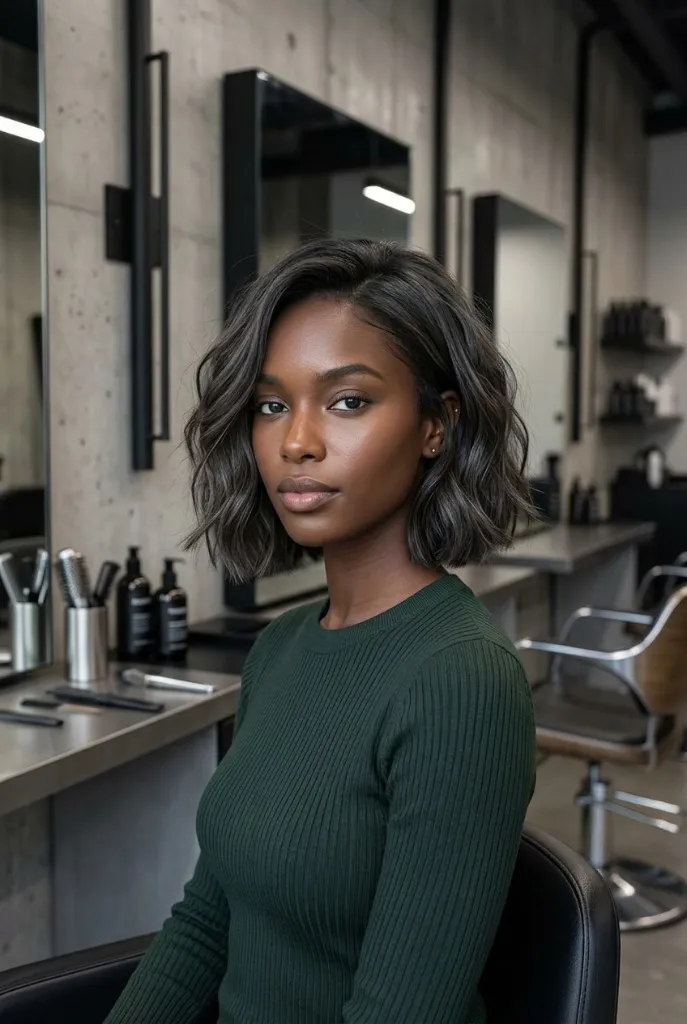
The cut uses a combination of disconnected layers at the crown and point-cut texturizing through the mid-lengths — a hybrid approach that creates lift at the top while maintaining soft, piece-y movement below. The disconnection at the crown means those top layers aren’t blended into the rest; they sit on top with their own independent movement pattern. This dual technique suits medium-to-thick, 2B–3A textured hair with high density, where both volume reduction and shape definition are necessary. The combined technique held its layered, textured effect for about 6 weeks, with the disconnected crown layers growing out more gracefully than the point-cut mid-lengths. The color is natural — a deep, cool-toned dark brown with no visible highlights or lowlights, just the hair’s own tonal variation catching light.
Scrunch a curl cream through damp hair and air-dry completely. A light application of dry shampoo at the roots on day two maintains the volume from the disconnected crown layers. Trims every 6 weeks keep both the crown and the mid-length texturizing in balance — if you let the crown layers grow too long, they stop sitting independently and collapse into the rest of the bob. Mechanically, the crown disconnection creates a shorter, lighter “lid” of hair that naturally lifts away from the head, while the point-cut mid-lengths prevent the heavier under-sections from forming a triangle. This is a particularly strong option among mid-length cuts for the season if you’re between a true bob and something longer. Skip if you want a sleek, flat crown — the disconnection is designed to create lift, and you can’t blow it flat without a fight. Lift and texture.
18. The Ash Mushroom Blunt Wave Bob
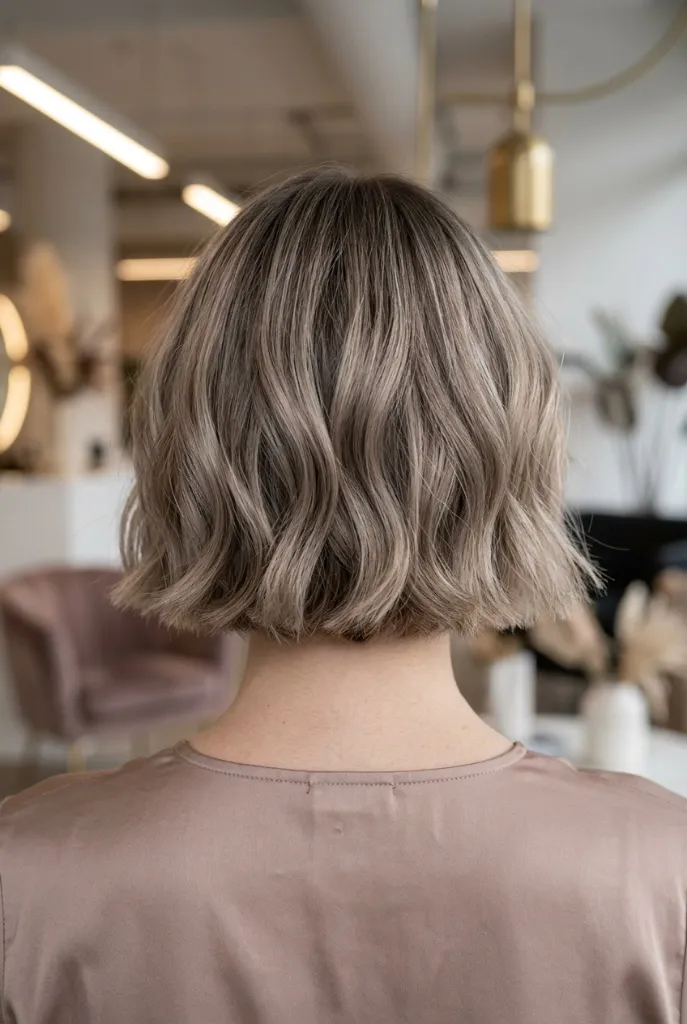
This back view showcases a precision blunt cut — every strand hitting at exactly the same length, creating a dense, solid hemline that gives the waves a defined boundary. There’s no layering, no texturizing, no razoring — the entire effect comes from the blunt weight and the hair’s natural wave pattern pushing against that uniform line. This purist approach works best on medium-density 2A–2B hair, where the natural wave is gentle enough to cooperate with the strict hemline without flipping or bending unpredictably. The blunt line maintained its precision for about 5 weeks — after that, different growth rates across the head start to blur the sharpness. The color is an ash mushroom bronde — a gray-leaning, cool-toned blend of light brown and dark blonde with no warmth whatsoever, the kind of shade that looks intentionally muted.
Air-drying works well here — a lightweight mousse scrunched through damp hair adds just enough hold to keep the waves defined without stiffness. Trims every 5–6 weeks are necessary to maintain that crisp hemline; a blunt bob that’s grown out even slightly reads as “needs a cut” in a way that layered bobs don’t. The uniform length creates consistent weight distribution, which is why the waves form in such a regular, even pattern — there’s no layering to disrupt the wave’s natural rhythm. An ash-toned gloss treatment every 6–8 weeks keeps the mushroom tone from drifting warm as the color processes. Not for anyone with very thick hair or a strong wave pattern — the blunt line will fight against heavy waves, creating a boxy shape. Muted and sharp.
19. The Champagne Blonde Side-Part Wave Bob
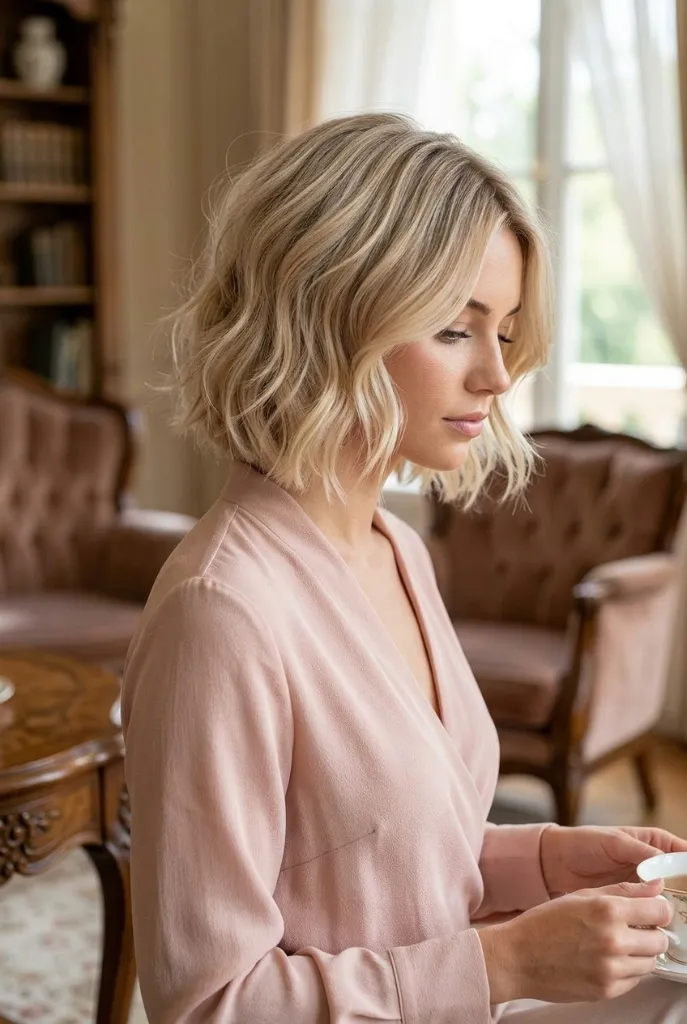
A deep side part combined with face-framing layers — layers cut specifically around the front sections to follow the jawline and cheekbone — gives this bob its elegant, swept-to-one-side quality. The face-framing layers are slide-cut for soft, tapered ends that blend into the longer back length without a visible break line. This structure is tailored for fine-to-medium 1C–2A hair, where the deep side part creates the illusion of thickness on the heavy side. The face-framing layers maintained their sweeping direction for about 6 weeks, though training the part with a blow-dry keeps it in place longer between cuts. Color is a true champagne blonde — warm but not golden, sitting between buttercream and linen with a soft, creamy undertone.
Blow-dry with the deep side part in place, using a medium round brush to sweep the heavier side back and away from the face. A flexible-hold smoothing serum keeps flyaways down without stiffening the movement. Trims every 6–7 weeks, with the face-framing pieces needing attention slightly sooner than the back length. The slide-cut face-framing creates a gentle cascade effect — hair falls toward the jaw in progressively longer pieces, drawing the eye downward and elongating the face. This is one of the more refined short summer haircuts for 2026 — it reads as effortless but requires a blow-dry to reach its full potential. Skip if you prefer air-drying exclusively — the deep side part collapses without heat styling. Swept elegance.
20. The Ash Blonde Dimensional Lob
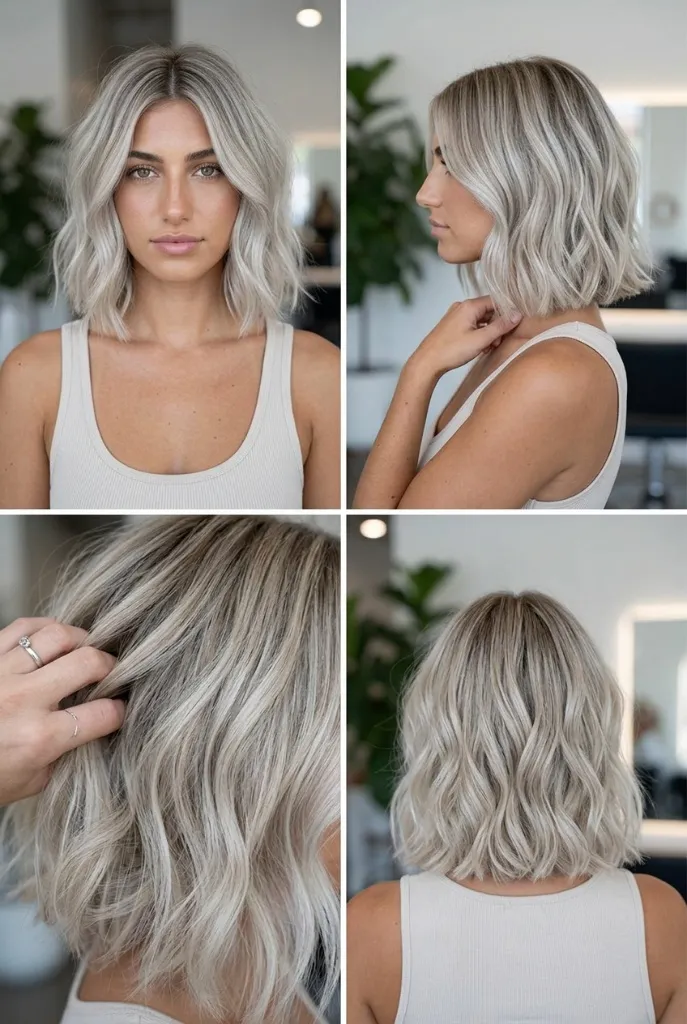
This four-angle view reveals a technique called “undercutting the weight line” — the interior layers are cut shorter than the exterior, removing density from underneath while keeping the surface hair at full length. The result is a lob that moves and swings without looking thinned-out or wispy from the outside. It’s engineered for thick, high-density 2A–2C hair, where bulk reduction is necessary but visible thinning would look wrong. The undercut weight removal maintained the bob’s airy movement for a full 8 weeks before the interior layers grew long enough to rebuild the bulk. Color is an ash blonde balayage with a visible root shadow — smoky at the base, brightening to cool linen and silver-kissed blonde through the lengths.
A texturizing paste through the mid-lengths and ends after air-drying gives separation and movement without crunch. Trims every 7–8 weeks — the exterior length is forgiving, and the interior layers grow out invisibly. The undercut weight removal works because it creates airflow channels inside the hair that allow the bob to move in response to gravity and motion rather than being held in place by its own density (my stylist described it as “giving the hair room to breathe,” which is technically accurate). This is excellent for anyone exploring wavy bob haircuts for summer 2026 who’s been turned off by bobs in the past because their thick hair always went triangular. Not for fine or low-density hair — there’s nothing to remove underneath, and you’d be thinning hair that’s already thin. Finally, a bob that moves.
21. The Silver Ice Blunt Wave Bob
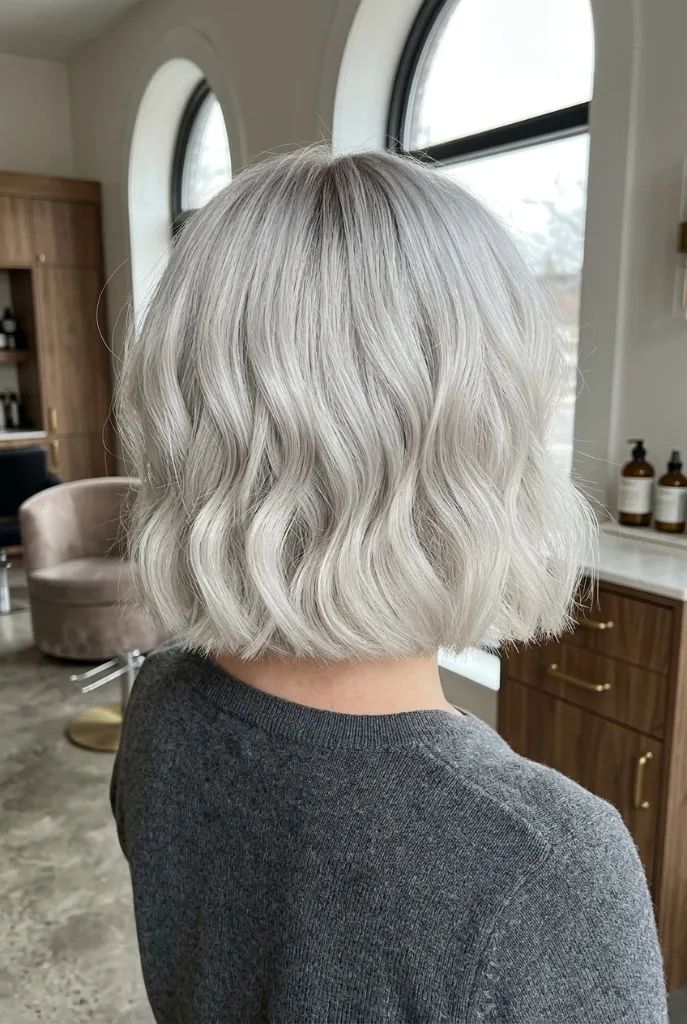
A blunt perimeter combined with internal notch-cutting — where small V-shaped notches are cut into the interior layers to create movement channels — gives this silver bob its combination of solid shape and soft internal movement. The notch-cutting is subtler than point-cutting, removing less weight per section while still breaking up density in the areas that tend to puff. This technique is ideal for medium-density 1C–2B hair, and it held its internal movement for about 7 weeks while the blunt perimeter stayed crisp for 5. The silver ice color is the lightest on this list — a nearly white platinum with cool, blue-silver undertones and absolutely zero yellow.
Purple shampoo every other wash, a blue-toned toner every 4–5 weeks, and a bond-strengthening treatment weekly — that’s the maintenance reality of silver this bright. Style with a smoothing serum and air-dry, or blow-dry with a round brush for a smoother finish. Trims every 5 weeks to maintain the blunt line (or 7 weeks if you don’t mind a slightly softer hemline). The notch-cutting creates discrete internal movement without altering the surface texture, which is why the bob can look both blunt and mobile at the same time — a visual contradiction that makes this cut consistently interesting to look at. Skip if you have a warm skin undertone that’s not compatible with icy tones — silver platinum can wash out warm complexions significantly. Silver, sharpened.
22. The Warm Honey Casual Wave Bob

This cut uses a technique called channel-cutting — where the stylist cuts thin vertical channels into the hair’s body to create internal texture and reduce weight, rather than layering horizontally. The vertical channels allow the hair to move in three dimensions rather than just swinging side to side, which is why the waves here look tousled and lived-in rather than structured. Channel-cutting works across fine-to-medium 2A–2B textures, and the internal channels maintained their textured, multi-directional movement for 6 weeks — roughly the same as traditional layering, but with a more natural grow-out pattern. The color is a warm honey blonde with darker, syrup-toned roots — golden without being brassy, with a warmth that reads as sun-touched rather than artificial.
A salt spray scrunched into damp hair and fully air-dried is the styling sweet spot here. Trims every 6–7 weeks — the vertical channels grow out less noticeably than horizontal layers, so you get more time between appointments without the shape deteriorating. Mechanically, the vertical cuts create separate “curtains” of hair within the overall bob that move independently, mimicking the way naturally wavy hair behaves when it’s just the right length and just the right density. This is one of those wavy bob haircuts for summer 2026 that genuinely looks like you didn’t do anything to it, even though the cutting technique is quite precise. Not for anyone who wants a defined, structured wave pattern — channel-cutting creates randomness by design. Lived-in, perfected.
23. The Buttercream Blonde Soft Contour Bob
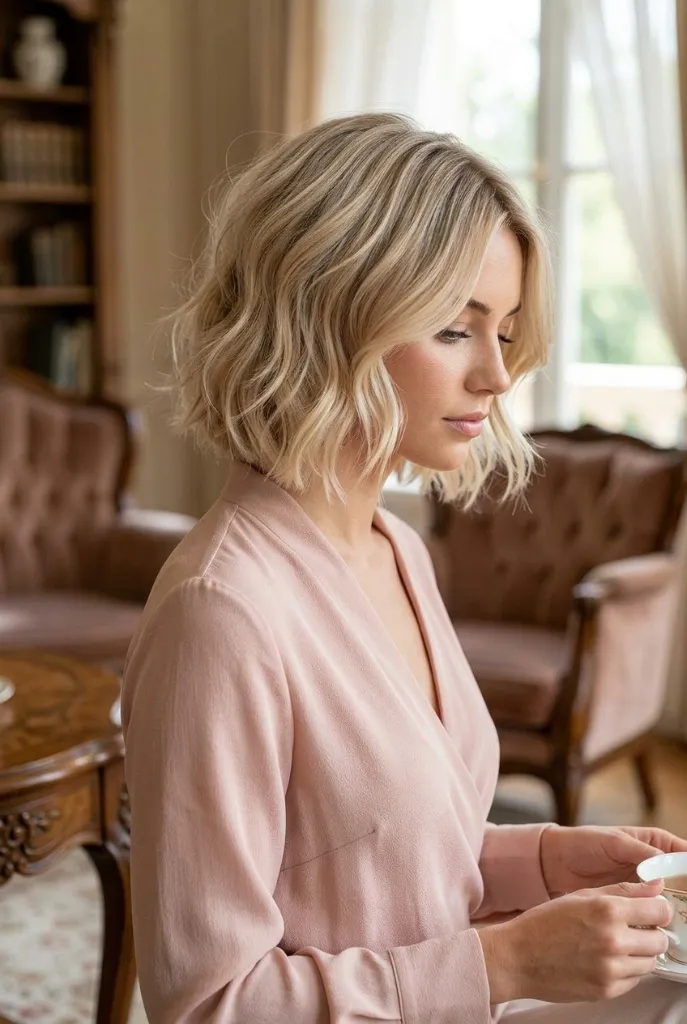
Contour layering — where the layers are customized to follow the specific angles of the client’s face shape, jawline, and cheekbone placement — is the most personalized cutting technique on this list. Rather than a standard layering pattern applied to everyone, contour layers are mapped to your individual bone structure, which is why this cut frames the face so precisely. It suits fine-to-medium 1C–2A hair across oval, heart, and oblong face shapes, and the custom contour maintained its face-flattering precision for about 7 weeks before the layers started growing past their intended placement. The buttercream blonde here is warm, rich, and soft — a full-bodied golden blonde with the slightest vanilla undertone and no ash or ice.
Blow-dry with a medium round brush, focusing on directing the face-framing contour layers inward toward the jaw. A lightweight mousse through the roots for volume and a smoothing serum through the ends for polish give this cut its refined finish. Trims every 6–7 weeks are critical — contour layers are precision-cut to your face, so even moderate growth moves them out of position. The contour technique works because it treats hair as a three-dimensional frame around a three-dimensional face, rather than cutting it flat and hoping for the best — which is what makes the difference between a bob that’s “fine” and a bob that genuinely enhances your features. This cut benefits from a thorough consultation conversation with your stylist about your specific bone structure. Not for anyone who wants a quick, no-fuss cut — the consultation alone takes longer than most standard bob appointments. Contour, custom.