European summer outfits sound simple until you’re actually in Europe in July, standing on hot cobblestones, staring down a church dress code, and realizing your suitcase is full of pieces that made sense at home but suddenly feel loud, bulky, or wildly impractical.
Last July, I was sitting at a tiny café in Lyon, nursing an espresso that cost me €1.80, when a group of American women walked by. I clocked them instantly — the bright white sneakers, the oversized college tees, the massive crossbody bags bulging with guidebooks and portable chargers.
And I thought, with genuine affection because that was me five years ago: they’re having a great time, but they could be having a great time and feeling like they belong here.
Figuring out European summer outfits that actually work in real life — not in some Pinterest fantasy — took me several trips, a few packing disasters, and one truly humbling moment in a Milan boutique where a saleswoman looked at my athletic shorts and just… sighed.
So here’s everything I’ve learned, the honest version, from someone who has sweated through a Roman heatwave in the wrong fabric and lived to tell you what to wear instead.
If your default summer wardrobe runs more casual, you might also like my guides to chic hot weather outfits and casual summer outfits for women: real-life ideas. But if your goal is European summer outfits that feel polished, breathable, and believable, these are the principles that matter most.
Table of Contents
Why European Summer Outfits Often Go Wrong
Here’s the thing about American style versus European style in summer: we’re trained to optimize for different things.
In the U.S., summer dressing is about staying cool, being casual, and comfort above all else. Which — fair.
But in most European cities, women manage to look pulled together in 90-degree heat without appearing to suffer. How? It’s not magic. It’s fabric choice, fit, and a restraint with color and logos that most of us just weren’t raised with.
When I first started researching how to dress like a European woman, I went down a rabbit hole of blogs telling me to “just wear all black and a red lip.” That advice is… not wrong, exactly, but it’s painfully incomplete.
A Parisian woman’s summer wardrobe looks completely different from a Greek woman’s or a Scandinavian woman’s.
So let me break this down by what actually matters, universally, across the continent — the principles that hold up whether you’re wandering through Barcelona or taking a train to Vienna.
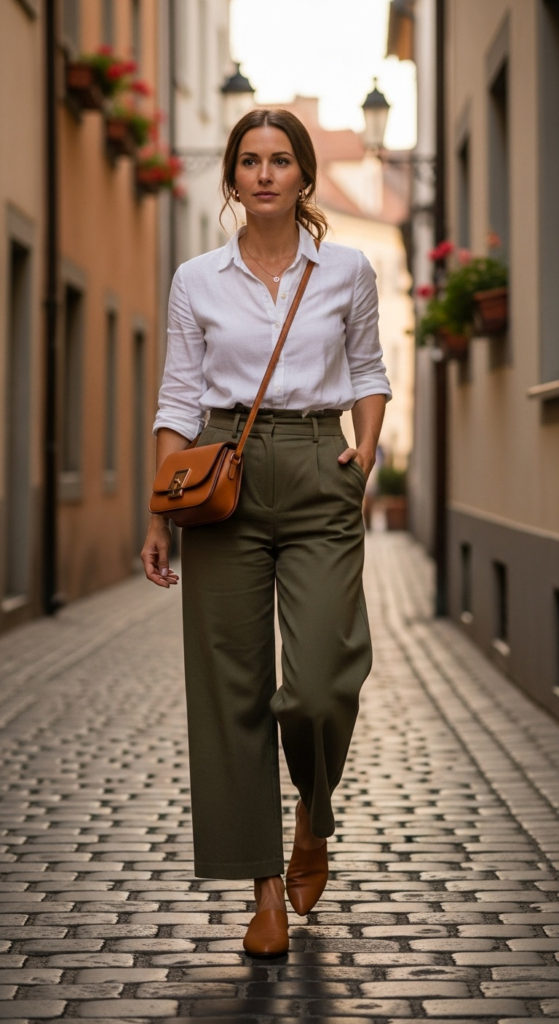
Alt text suggestion: European summer outfits woman walking on a cobblestone street in a white linen shirt, olive wide-leg trousers, and tan leather mules
What makes European summer outfits read as more effortless isn’t that they’re more expensive. It’s that they look considered. The silhouettes are easier, the fabrics breathe, the shoes make sense for real walking, and the overall effect says, “I got dressed on purpose.”
That’s a subtle difference, but it changes everything.
The Fabric Conversation Nobody Wants to Have
I’m going to say something that might sting: if your suitcase is full of polyester and rayon-blend “resort wear” from a fast fashion haul, you’re going to be miserable.
And you’re going to look it.
European summer style for women leans so heavily on natural fabrics — linen, cotton, silk, tencel — and there’s a practical reason for it. These fabrics breathe. They drape differently. They wrinkle in a way that somehow looks intentional and lived-in rather than sloppy.
I learned this the hard way in Seville two summers ago. I’d packed this cute matching set — a cropped top and wide-leg pants — that looked amazing on the hanger. It was some synthetic blend.
By 11 a.m. I was a sweaty, clingy disaster, and the fabric had this weird sheen in the sun that screamed “I bought this on a 2-for-$30 deal.”
Meanwhile, the Spanish women around me were gliding around in simple cotton dresses and linen separates looking like they’d just stepped out of an air-conditioned cloud.
My rule now: if I can’t confirm it’s at least 70% natural fiber, it doesn’t come to Europe with me. Period.
And there is real logic behind that instinct. REI notes that linen is typically especially breathable because the fibers are larger and the weaves tend to be more open, which is exactly why linen-heavy European summer outfits feel better in real heat than clingy synthetics do REI Co-op.
If you want your European summer outfits to look elevated without trying too hard, start with this one question before you buy anything: what is it actually made of?
That one habit will save you more outfit regret than any trend forecast ever could.
The European Summer Outfits Formula That Actually Works
Okay, this is the part you probably scrolled down for, so let me deliver.
These are the specific combinations I rotate through on every European trip. They’re not theoretical. I’ve walked 20,000 steps in each of them.
The Linen Pants + Simple Top
This is my absolute workhorse outfit.
A pair of high-waisted, slightly wide-leg linen pants in a neutral — I love oatmeal, white, or light khaki — with a fitted ribbed tank or a relaxed button-down.
Tuck the top in, always.
A half-tuck if you’re feeling casual, a full tuck for dinner. Add a belt if you want. This outfit works in Lisbon, works in Copenhagen, works literally everywhere.
I wore this exact combo in cream and white to wander around the Trastevere neighborhood in Rome last summer, and an Italian woman at a fruit stand told me she liked my outfit.
That might be the highest compliment I’ve ever received in my life. I’m still riding that high.

Alt text suggestion: European summer outfits for women with oatmeal linen pants, white ribbed tank, tan belt, and flat sandals at a Mediterranean market
This formula works because it hits the sweet spot between polished and practical. The top feels clean. The trousers feel cool. The entire outfit says “summer” without drifting into beachwear.
If you like outfit formulas that feel wearable in actual life, not just on mood boards, you’d probably also enjoy casual summer outfits for Black women for more grounded styling ideas.
The Midi Dress
If I had to pack one single item for a summer Europe trip, it would be a midi dress.
Specifically, a solid-color or subtle-print midi in a breathable fabric with some structure — not a shapeless muumuu, not a skin-tight bodycon situation. Something that skims your body, hits mid-calf, and could go from a museum to a rooftop bar without a costume change.
I have this navy cotton midi dress with a subtle V-neck and a self-tie belt that has been to six countries with me. It owes me nothing.
I pair it with flat leather sandals during the day and swap to a low block heel at night. Done.
The beauty of the midi dress in European summer outfits is that it removes decision fatigue. It photographs well. It layers easily with jewelry and a bag. And it saves you when you have one of those days where you want to look like you tried without actually trying very hard.
The Trouser-Short
I know, I know — I just implied shorts are a tourist giveaway.
But there’s a massive difference between cut-off denim shorts and a tailored, knee-length or bermuda-length trouser-short in a structured fabric.
Think of them as trousers that got a summer haircut.
In ecru, navy, or black linen, styled with a tucked-in silk camisole and nice sandals, they look incredibly European. I see them everywhere in the south of France.
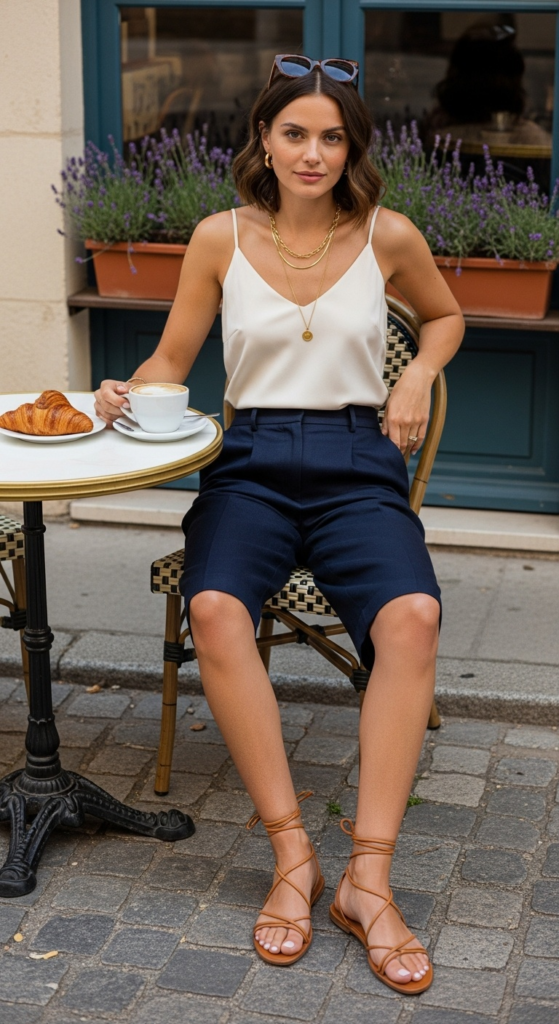
Alt text suggestion: European summer outfits café look with navy bermuda linen shorts, cream silk camisole, layered gold necklaces, and tan flat sandals
This is one of the easiest ways to make shorts feel grown-up.
If you’re drawn to more trend-forward styling, you can also borrow a little inspiration from summer street style outfits for women 2026 while keeping the same tailored, low-key base.
Shoes: The Make-or-Break Detail
Can we talk about shoes for a second?
Because this is where most Americans blow their cover immediately.
I get it — you’re walking miles every day, you want support. But the chunky bright-white athletic sneaker with ankle socks is doing you zero favors in the style department.
Here’s what to wear in Europe summer on your feet: leather sandals with a low profile, clean white leather sneakers with a slim profile, espadrille wedges for evenings, and a comfortable low block-heeled mule if you want a dressier option that won’t destroy your feet on cobblestones.
My personal go-to is a pair of tan leather fisherman sandals I bought in Portugal three years ago. They’ve molded to my feet, they go with absolutely everything, and they handle cobblestones without me wincing.
I also pack one pair of simple white leather sneakers for heavy walking days — the trick is keeping them clean. European women wear sneakers too, but they’re sleek, they’re tonal, and they look deliberate.

Alt text suggestion: European summer outfits shoe options with tan fisherman sandals and clean white leather sneakers on cobblestones
If your personal style runs sportier, don’t panic. You do not need to abandon comfort. You just need a more refined version of it. A sleek sneaker works. A heavy running shoe usually doesn’t.
That distinction matters more than people think.
And if you want to lean into athletic influences without tipping into tourist mode, save your tennis-inspired pieces for outfits that feel cleaner and more intentional, like the ideas in sporty chic summer tennis outfits 2026 and tenniscore outfits off court 2026.
The Color Palette That Blends In
I know everyone’s obsessed with dopamine dressing and bold color right now, and listen — I love a good red dress moment.
But if you want to not look like a tourist in Europe, your best friend is a restrained palette.
Think white, cream, navy, olive, tan, terracotta, soft blue, black.
These are the colors I see dominating European streets every single summer I visit, and they have this incredible ability to look expensive even when they’re not.
Here’s my honest take: you can bring one bold piece. Maybe it’s a gorgeous cobalt blue linen shirt or a terracotta sundress.
But let that be the star, and let everything else be quiet.
European women tend to let one element speak — a beautiful print scarf, a statement earring, a striking bag — and keep the rest muted.
It’s restraint that reads as confidence.
For summer outfits for a Europe trip in 2026, I’d say the tones I’m seeing trend locally lean into warm neutrals and soft pastels — think butter, sage, washed denim blue — but the principle stays the same.
Quiet palette. Quality over quantity. Let the architecture be the loud one.
If prints are more your thing, I’d still keep them controlled. One elegant pattern can work beautifully, especially if the shape is classic. For that approach, my guide on how to wear polka dots without looking costumey is a helpful companion.
Accessories: Less, But Better
This one’s going to be quick because the rule is simple: wear fewer accessories, but make each one count.
A good pair of sunglasses, a simple gold or silver necklace you don’t take off, a quality leather bag that’s small enough to be practical but structured enough to look intentional.
I ditched the oversized tote bag on European trips two years ago, and it changed everything.
I carry a compact leather crossbody — something that fits my phone, a card holder, a lip balm, and my tiny sunscreen. That’s it.
If I need more, I bring a small canvas tote that folds flat in my bag for market shopping or museum gift shops.
But my main bag? Small, structured, done.
One more thing — a scarf.
I know it sounds like a cliché, but a lightweight silk or cotton scarf is genuinely the most versatile accessory you can pack. Tie it on your bag, wear it in your hair, drape it over your shoulders when you walk into a church that requires covered shoulders.
This has saved me three separate times.
And yes, that practicality matters. The Vatican Museums explicitly state that sleeveless garments and shorts above the knee are not permitted, which is exactly why a lightweight scarf or extra layer earns its place in smart European summer outfits Vatican Museums.
It’s not performative — it’s practical.
And that’s very European.
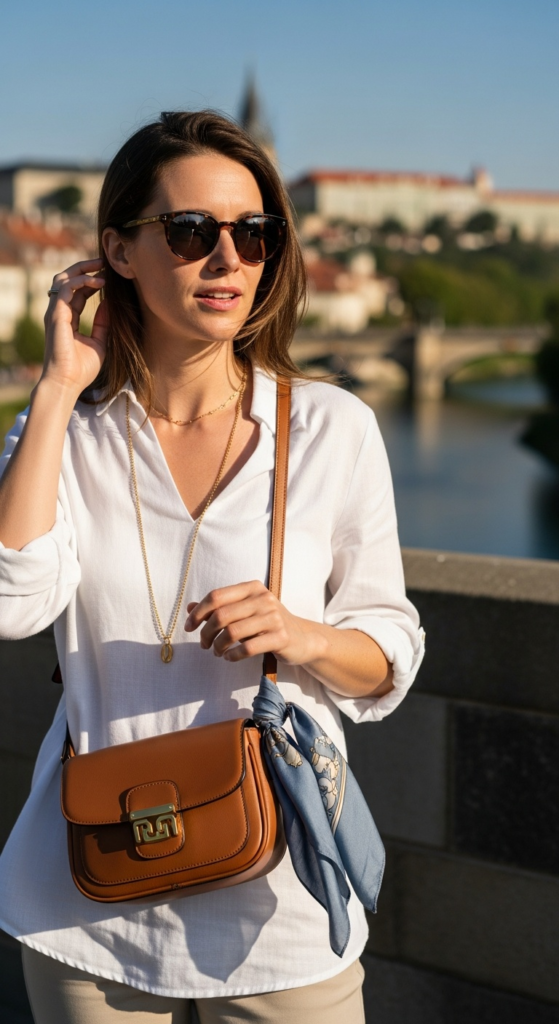
Alt text suggestion: European summer outfits accessories featuring a white linen blouse, structured tan crossbody bag, silk scarf, and sunglasses on a sunny bridge
For a slightly more romantic take on this same idea, you may also like vintage summer outfits for women, especially if scarves, delicate jewelry, and timeless silhouettes are already your thing.
How to Pack European Summer Outfits Without Losing Your Mind
I’m a carry-on-only traveler for Europe trips, and yes, people look at me like I’m unhinged when I say that.
But it works because of one concept: a capsule packing system where everything goes with everything.
For a 10-day European summer trip, I pack roughly: three bottoms, four tops, two dresses, two pairs of shoes, and one light layer for evenings.
That’s it.
Everything is in the same color family — usually cream, tan, navy, and white — so I can mix and match without thinking.
The key that took me embarrassingly long to figure out: lay everything out before you pack and make sure every top works with every bottom.
If something only goes with one other piece, it doesn’t come.
Ruthless, maybe. But I’ve never once been standing in a hotel room in Florence wishing I’d packed more. I’ve stood there plenty of times wishing I’d packed less.
Roll your linen — it’s going to wrinkle anyway, and honestly, slightly rumpled linen is part of the aesthetic.
Hang it in a steamy bathroom when you arrive if it bothers you.

Alt text suggestion: European summer outfits capsule wardrobe flat lay with linen separates, midi dresses, leather sandals, white sneakers, and a structured bag
If you’ve ever doubted the carry-on-only life, the logic is sound: pack less, carry less, and make better choices. That same philosophy has been a long-running travel rule on Rick Steves’ packing-light guide, which basically comes down to this: there are two kinds of travelers, those who pack light and those who wish they had Rick Steves.
A cohesive capsule also makes your outfits look more expensive because repetition creates visual consistency. The same sandals with linen pants. The same bag with a midi dress. The same gold hoops with everything.
That repetition is not boring. It’s stylish.
What European Women Are Actually Wearing in 2026
I try to stay honest about this because “European style” is not a monolith.
But based on what I observed last summer and what I’ve been seeing from street style in early 2026, a few things stand out.
Longer hemlines are still going strong — the knee or below.
Quiet, tonal outfits with interesting textures rather than bold prints.
Flat shoes are dominant by a mile.
And there’s a real return to wardrobe classics: the white shirt, the perfect trouser, the understated gold jewelry.
What I’m not seeing on stylish European women: athleisure as streetwear, graphic tees, flip-flops, tiny micro-mini skirts, or anything with a massive visible logo.
That doesn’t mean those things are wrong — style is personal — but if your goal is to blend in and channel how to dress like a European woman this summer, lean classic, lean simple, lean quality.
This is also where European summer outfits separate themselves from trend-chasing. They may nod to trends, sure. But they’re rarely built around five trend pieces at once.
Instead, the outfit usually starts with a classic base and adds one interesting twist — maybe a sculptural earring, a butter-yellow bag, a better sandal, a fuller trouser, a scarf tied in a way that feels personal.
That’s why these looks age well in photos, and it’s why they’re worth copying.
What Not to Pack If You Want to Blend In
This is probably the least glamorous part of the conversation, but it matters.
If your goal is European summer outfits that don’t scream tourist, there are a few pieces I’d leave at home unless you truly love them enough to not care.
First: oversized college tees and graphic slogan tops.
Second: gym shorts, especially the shiny athletic kind.
Third: flip-flops for city walking.
Fourth: giant overstuffed bags that pull your whole outfit off balance.
And fifth: anything so tight, short, sheer, or synthetic that you’re visibly uncomfortable by noon.
Most style mistakes on summer trips are not about fashion. They’re about mismatch.
A beach outfit in a city center feels wrong. A sporty airport outfit at a museum feels wrong. A nightclub dress at a morning market feels wrong.
European summer outfits work best when they fit the setting as much as the weather.
That’s also why I think “looking like a local” is less useful than “looking appropriate, polished, and at ease.”
You don’t need to costume yourself into someone else’s identity.
You just want to avoid the tiny styling choices that instantly read as rushed: the wrong shoes, the wrong bag, the wrong hemline, the wrong fabric, the loud logo, the outfit that belongs to a different climate entirely.
When in doubt, simplify.
Final Thoughts
Here’s my last thought, and I mean this genuinely: the best European summer outfits aren’t about looking perfect.
They’re about looking considered.
Like you thought about what you put on for five minutes instead of zero.
Like you respect yourself and the place you’re visiting enough to put a little intention into getting dressed.
My favorite style memory from traveling in Europe isn’t some grand outfit moment.
It’s a Tuesday morning in Lisbon where I put on a white linen shirt, my favorite tan sandals, and simple gold earrings, and I just… felt like myself.
Not costuming, not performing, just me in good clothes in a beautiful place.
That’s the whole goal.
So wherever you’re headed this summer — whether it’s the Amalfi Coast or a tiny village in Provence — pack less, choose well, and trust that simplicity is its own kind of statement.
You really don’t need much.
Just the right things.
Now go have the best trip. I’m genuinely jealous.
— Stella x