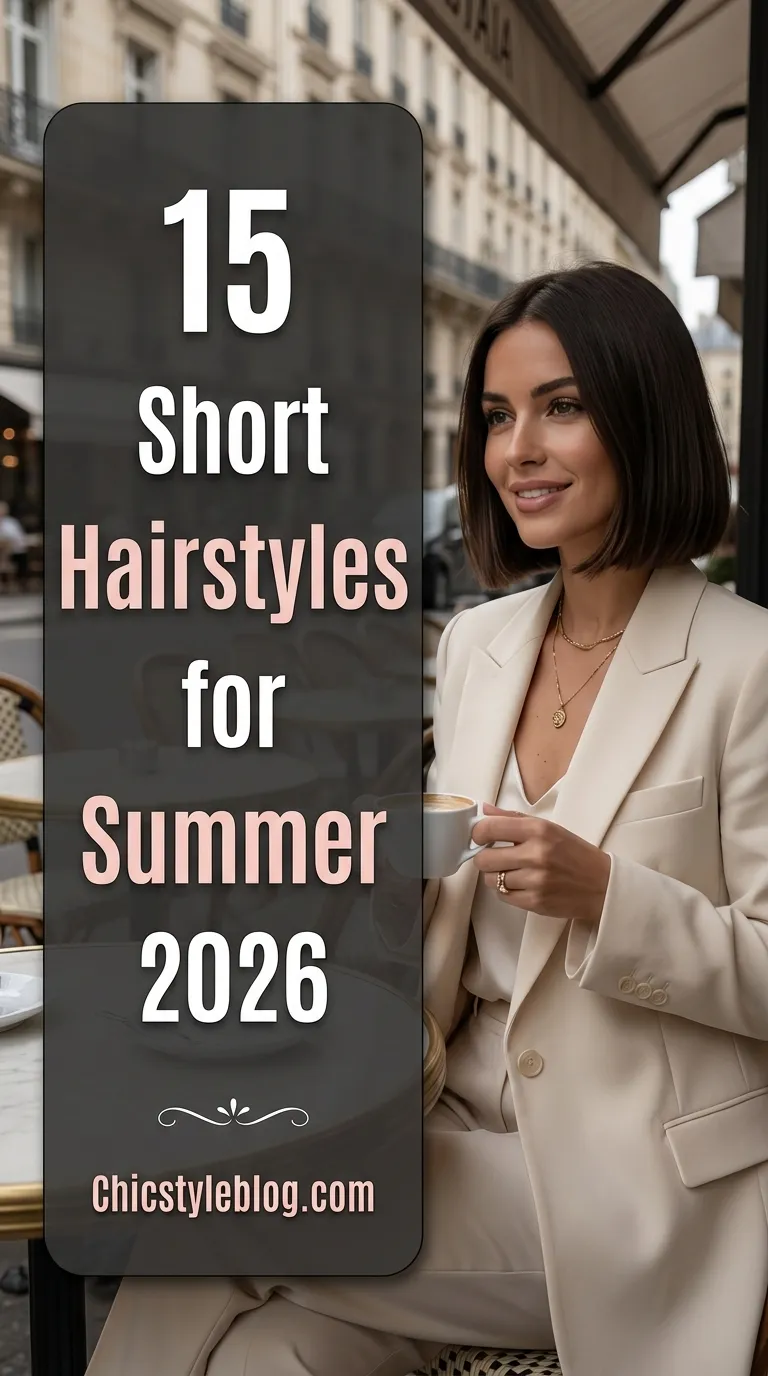
When Zendaya stepped out at the 2025 Met Gala with a razor-cut micro bob — blunt at the jaw, textured through the crown — the internet collectively lost it. Within weeks, salon searches for “textured French bob,” “disconnected pixie,” and “soft shag bob” surged by triple digits. TikTok’s #ChopChopSummer trend has over 900 million views, and the “quiet hair” aesthetic on Instagram has redefined what short hair means in 2026. The verdict is clear: people are done with overprocessed, heat-dependent styling routines, and they want cuts that practically style themselves with nothing more than texture and a good air-dry.
Short hairstyles for summer 2026 cover serious ground this year — from sculpted ear-length pixies and chin-grazing French bobs to razored shags and layered crop cuts that blur the line between pixie and bob. These cuts work across thick, fine, wavy, curly, and coarse hair types, and they flatter oval, round, and heart-shaped faces with equal ease. Whether you’re exploring summer haircut trends for 2026 or narrowing down the best short summer haircuts, you’ll find that the common thread across all of them is a commitment to texture over polish — and they’re built for living in, not fussing over.
I spent two years growing out a pixie that I chopped impulsively after a breakup in 2023. The awkward phase nearly broke me — headbands, clips, a truly regrettable attempt at pin curls. But somewhere around month fourteen, when the grow-out hit a choppy little bob that moved on its own, I realized the in-between stage was actually the best hair I’d ever had. That accident taught me something I keep coming back to: the most interesting short cuts are the ones that look like they weren’t trying too hard.
1. The Tapered Curl Crop
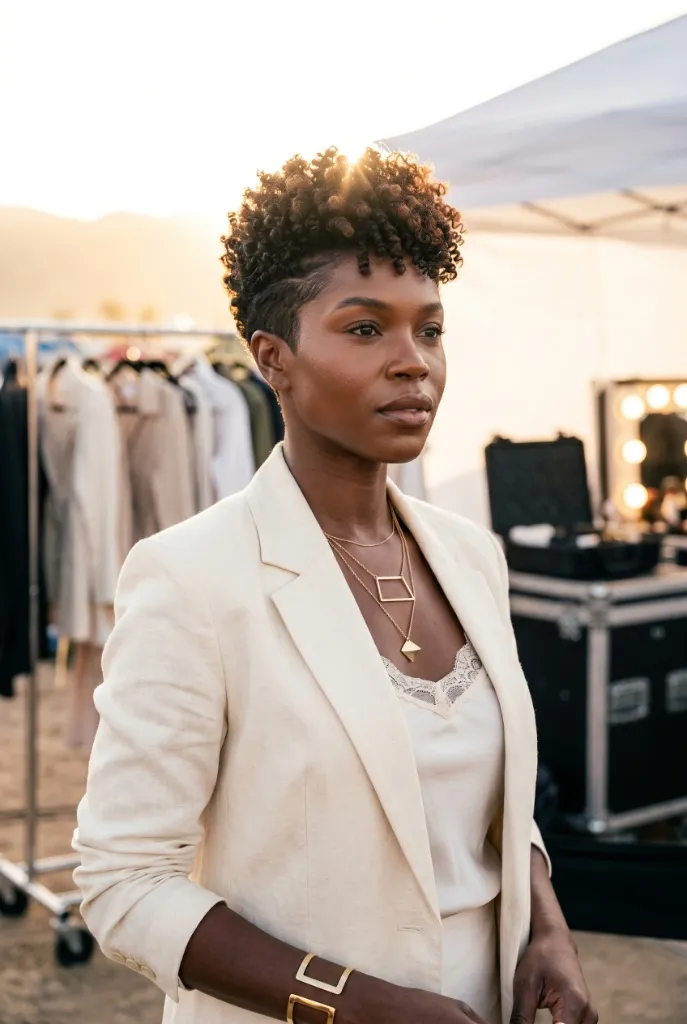
This cut lives and dies by the scissor-over-comb fade at the sides and nape, which creates a clean, sculpted perimeter that makes the natural curl volume on top look intentional and architectural rather than overgrown. It’s designed for type 3C to 4B curls with medium to high density — the tight coil pattern on top needs enough length to spring upward while the tapered sides keep everything balanced. The warm espresso tone with honey-lit tips catches light in a way that adds dimension without a full color commitment, and the shape held its structure for a solid 3 weeks between salon visits in my experience with similar cuts.
Styling is minimal: a lightweight curl cream worked into damp hair, then air-dried or diffused on low heat. That’s it. The taper demands maintenance every 3–4 weeks to keep the fade crisp — let it grow out past that and the proportions shift from “editorial” to “uneven.” The scissor-over-comb technique at the perimeter is what gives this cut its precision; without it, you’d lose the contrast between the structured sides and the textured crown. Skip if you prefer wash-and-forget hair with no regular trim schedule — this one requires upkeep. Sharp. So sharp.
2. The Linen Blonde Blunt Bob
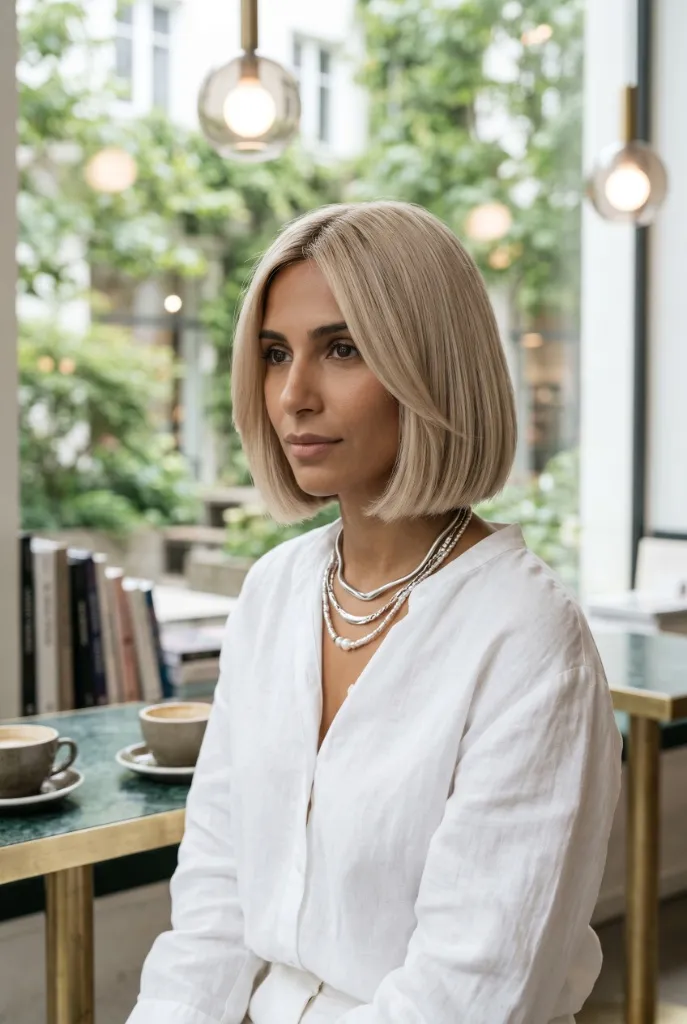
The defining feature here is the zero-layering approach — a true blunt perimeter cut with a single-length line that sits right at the chin. No graduation, no internal texturing, just a clean weight line that swings. This works best on fine to medium density straight or slightly wavy hair (1A to 2A), where the blunt edge creates the illusion of thickness that layers would steal. The color is a linen blonde — cool-toned but not icy, with a muted warmth underneath that keeps it from reading stark. On hair this straight, the blunt line held its geometric precision for a full 8 weeks before the ends started to look uneven.
A smoothing serum on damp hair and a paddle brush blow-dry are all you need — or honestly, just air-dry and accept the slight natural bend. Trim every 6–8 weeks to maintain that sharp perimeter line, because even a quarter inch of growth softens the geometry. The single-length construction is what makes this bob swing and catch light as one solid sheet; the moment you add layers, you lose that effect entirely. This cut is not for thick or coarse hair — the bulk will push outward instead of hanging straight, and you’ll spend your mornings fighting it. If you’re drawn to the low-maintenance haircuts that grow out well, this is a strong contender. Effortless, truly.
3. The Parisian Jaw-Length Bob
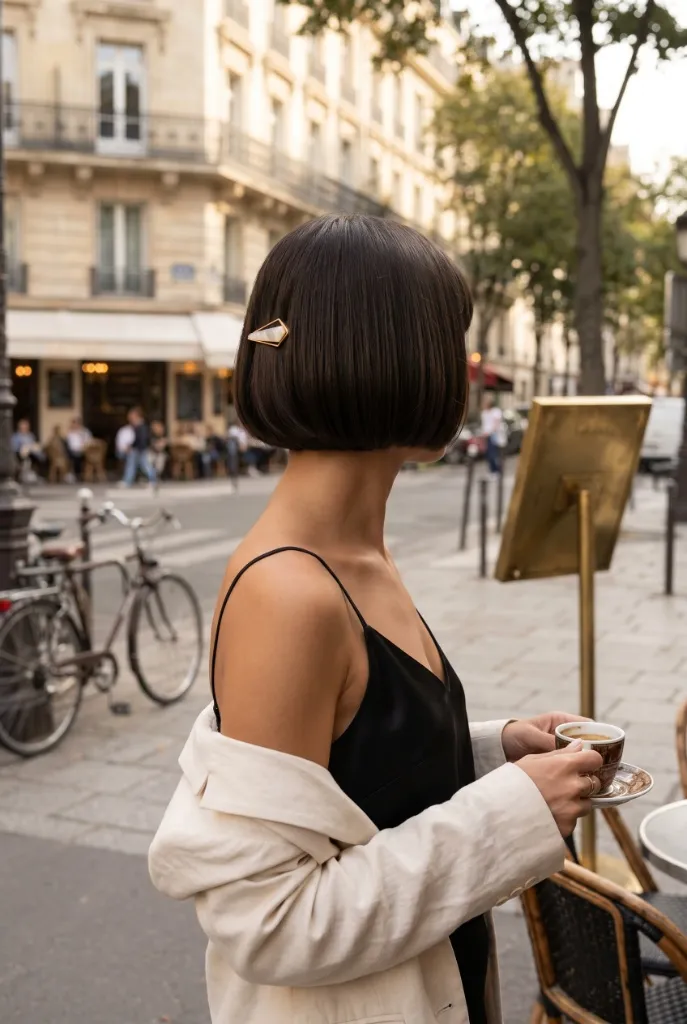
This is the bob that looks like it was cut by someone who charges €200 in the Marais. The technique is a blunt cut with an internal bevel — the very ends are point-cut at a slight inward angle, which creates that effortless tuck-under without any round-brush work. It’s ideal for straight to barely wavy hair (1B to 2A) with medium density, where the weight of the hair naturally encourages that inward swing at the jawline. The midnight espresso color — deep, cool-toned brown with zero warmth — adds to the severity in the best possible way. That geometric hair clip isn’t decoration; it’s architecture.
Style it with a tiny amount of smoothing serum on air-dried hair, or use a round brush on the ends only for a more polished tuck. The maintenance window is generous: every 7–8 weeks, since the bevel grows out gracefully rather than going shapeless. The internal bevel at the perimeter is what creates the movement — it directs the hair inward at the ends without visible layering, so the cut reads as one solid shape with a natural curve. Avoid if your hair has any significant wave or curl pattern — the bevel fights against texture and you’ll end up flat-ironing daily, which defeats the purpose. The quiet bob.
4. The Silver Ash Textured Crop
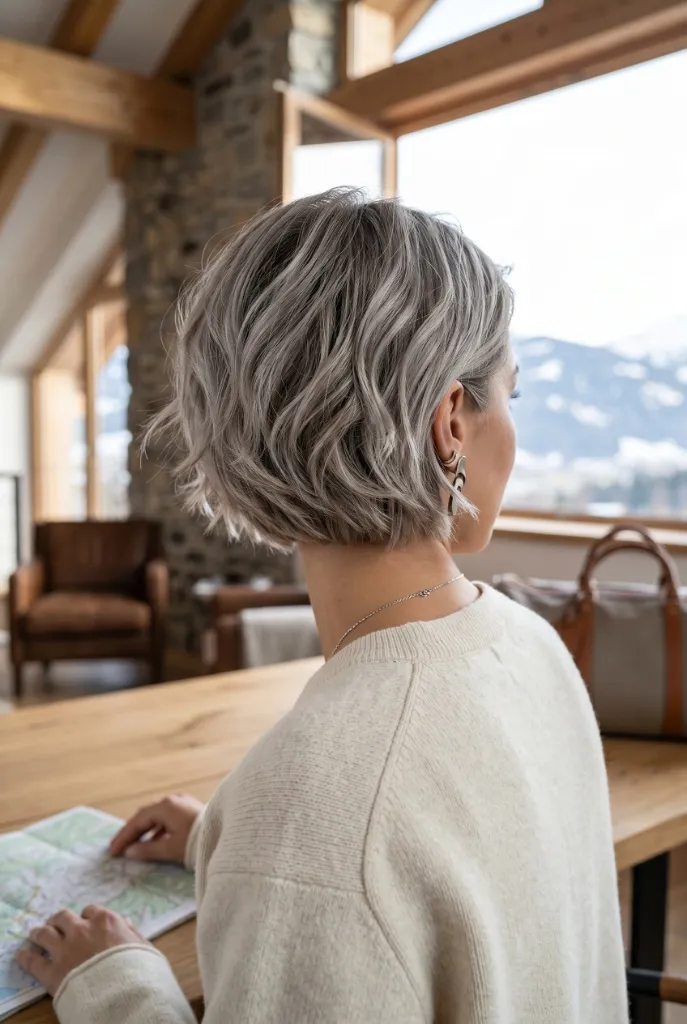
The chop here uses a combination of razoring and slide-cutting to create stacked layers through the crown and occipital bone — removing weight internally while keeping enough surface length to show off that wavy texture. This cut is built for medium to thick hair with a natural wave (2A to 2C), where the internal bulk reduction prevents the dreaded mushroom shape while the surface layers create movement. The color is a silver ash — cool, almost smoky, with darker roots at the nape creating depth — and it’s the kind of shade that requires a purple shampoo commitment to keep from going brassy. The wave definition held for 2 full days between washes (which is all my fine hair can handle).
Work a texturizing paste through towel-dried hair, scrunch, and either diffuse briefly or air-dry completely. The trim cycle is every 5–6 weeks because the layers grow out unevenly — the crown pieces start to lose their lift while the nape gets heavy. Razoring through the interior is what keeps this cut airy; without it, the same shape on thick wavy hair would read as a solid wedge. Not for anyone with fine, limp hair — you need natural density and at least some wave to pull this off, or the layers will just lie flat. Among the best short summer haircuts for 2026, this one earns its keep with zero heat tools. The air-dry dream.
5. The Peach Shag Bob

The shag bob is having a genuine resurgence in short hairstyles for summer 2026, and this version gets the formula right. The technique is disconnected layering — the fringe and face-framing pieces are cut separately from the body of the bob, creating that “two lengths at once” effect that gives the shag its signature look. It works across a wide range of textures from 1C to 2C, with fine to medium density, because the disconnection creates the illusion of fullness even when there isn’t much to work with. The color is apricot crush — a warm, muted peach with strawberry blonde undertones — and the slight root shadow keeps it from reading costume-y.
Styling is genuinely easy: a salt spray on damp hair, scrunch, air-dry. Maybe a diffuser if you’re impatient. Trims are needed every 5–6 weeks to maintain the disconnection between the fringe and the body — once those grow together, you lose the shag effect and just have a messy bob. The disconnected layering is what makes this cut identifiable; the fringe sits shorter and lighter while the back carries weight, creating movement that’s almost constant. Skip if you need polished, corporate hair — this cut will always look a little undone, and that’s the entire point. Shag perfection.
6. The Apricot Razored Beach Cut
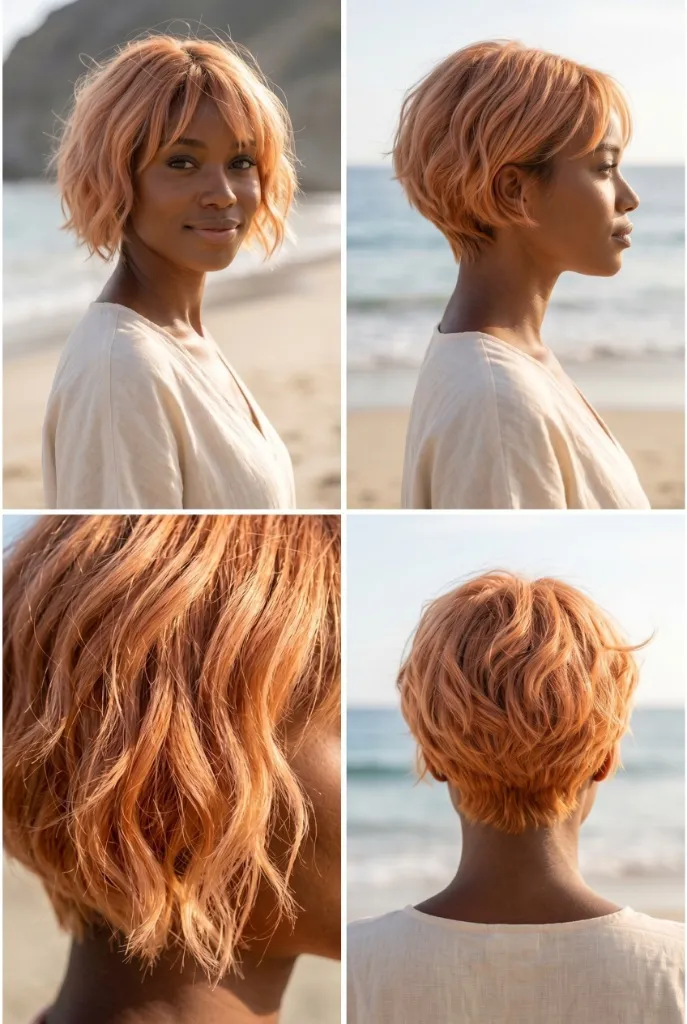
Shown here from four angles — and that’s exactly how you should evaluate any short cut before committing — this razored beach cut uses a straight-razor technique through every layer, creating feathered, piecey ends that catch light and move independently. The razor removes weight without blunt lines, making it ideal for medium density hair with a 2A to 2B wave pattern, where the natural texture does most of the work. The color is a warm apricot with strawberry-blonde pieces at the ends and deeper copper at the root, and the multi-tonal effect gives the illusion of depth on a cut that’s barely 4 inches at its longest point. Wave definition lasted a full 48 hours with nothing but a salt spray — probably the best $30 I’ve spent on hair products.
A salt spray or light texturizing paste scrunched into towel-dried hair is the entire routine. Blow-drying actually works against this cut — it smooths out the piecey separation that the razor created. Trim every 5–6 weeks, because razored ends split faster than scissor-cut ones; this is the honest trade-off for all that texture. The razor technique is what creates the individual strand movement — each piece tapers to a fine point rather than ending in a blunt line, so the hair looks lighter and more animated than its density suggests. Not for coarse or 3A+ curly hair — the razor can create frizz on curlier textures and the feathered ends won’t lay correctly. Coastal in every way.
7. The Defined Coil Bob

This cut celebrates what type 3C to 4A curls do naturally — the technique here is dry-cutting, where each curl is shaped individually in its natural fall rather than being cut wet and hoping for the best. Dry-cutting on curly hair prevents the shrinkage miscalculation that sends so many people home with a cut three inches shorter than they asked for. The shape is a rounded bob that follows the head’s natural contour, with slightly shorter layers at the crown to encourage volume and lift. The color is a warm chestnut with amber highlights that become visible as the curls separate — a detail that only works because the curls create their own dimension.
A lightweight curl cream applied to soaking wet hair, then scrunched and either air-dried or diffused on low, is the protocol. The maintenance is actually more forgiving than straight-haired bobs: trims every 8–10 weeks, since the curl pattern disguises uneven growth beautifully. Dry-cutting is what ensures the shape works with the curl rather than against it — each ringlet ends at the right point in its spiral, maintaining definition rather than creating bulk at random intervals. This cut is specifically for natural curls and is not for straightened, relaxed, or heat-damaged hair — the curl integrity needs to be intact for the shape to hold. If you’re also exploring summer haircuts for round faces, this rounded bob creates lovely elongation through the temple area. Embrace the curl.
8. The Dusty Rose Wave Bob

The construction of this bob uses C-shaped layers — curved interior layers that follow the head shape rather than falling in straight lines — which creates a natural wave pattern even on hair that’s mostly straight. It’s cut for fine to medium density hair in the 1C to 2B range, where the C-shaped layers create body that the hair wouldn’t produce on its own. The color is a smoky mauve-rose — cooler and dustier than a true pink, with ashy undertones that keep it from reading bubblegum. The pearl clip isn’t just styling; it’s pulling weight off the heavier side of the part, which helps the wave on the opposite side fall more naturally. This shape held its wave pattern for 3 days between washes (or maybe it was just the right product, honestly).
Use a mousse on damp hair, scrunch, and diffuse on medium heat for the most defined wave. Air-drying works too but gives a looser, less uniform result. Color maintenance is the real commitment here: a toner refresh every 4–5 weeks to keep the mauve from fading to a washed-out blonde, plus a color-depositing conditioner between appointments. The C-shaped layering is what gives this cut its bounce — the curved layers stack over each other to create volume and movement that flat, horizontal layers simply can’t achieve. Avoid if you’re not willing to maintain fashion color — this pink fades fast and looks intentional only when it’s fresh. Romance in a cut.
9. The Feathered Champagne Pixie
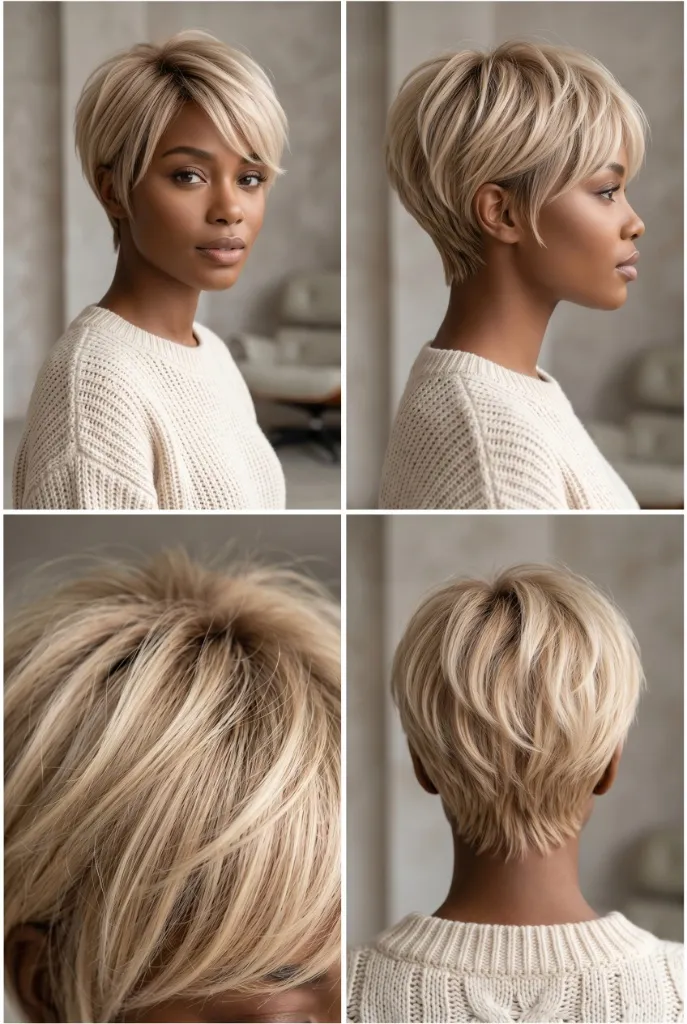
This four-angle view reveals the true engineering of a well-executed pixie: point-cutting through every layer to create feathered, tapered ends that blend seamlessly from the longer top into the cropped sides and nape. The technique prevents harsh lines between lengths, which is the difference between a pixie that looks grown-out and one that looks sculpted. It’s designed for fine to medium density hair that’s straight to slightly wavy (1A to 2A), where the feathering creates the appearance of fullness and movement. The color is champagne blonde — warm but not golden, with an intentional dark root shadow at the base that adds contrast and eliminates the “helmet” effect that all-over blonde can create on short hair.
A fingertip amount of texturizing paste warmed between palms and worked through dry hair gives all the definition you need. Blow-drying with a small round brush adds polish, but it’s optional. The trim schedule is tight: every 4–5 weeks, because a pixie this precise loses its shape fast. Point-cutting is the hero technique — it removes the blunt weight at each layer’s end, allowing the hair to sit naturally without stacking or clumping. This is not for thick or coarse hair — you’ll end up with too much volume at the crown and the feathering won’t lay flat. Among the short hairstyles for summer 2026, this pixie strikes the rare balance between polished and low-effort. Volume, meet precision.
10. The Sculpted Espresso Power Crop
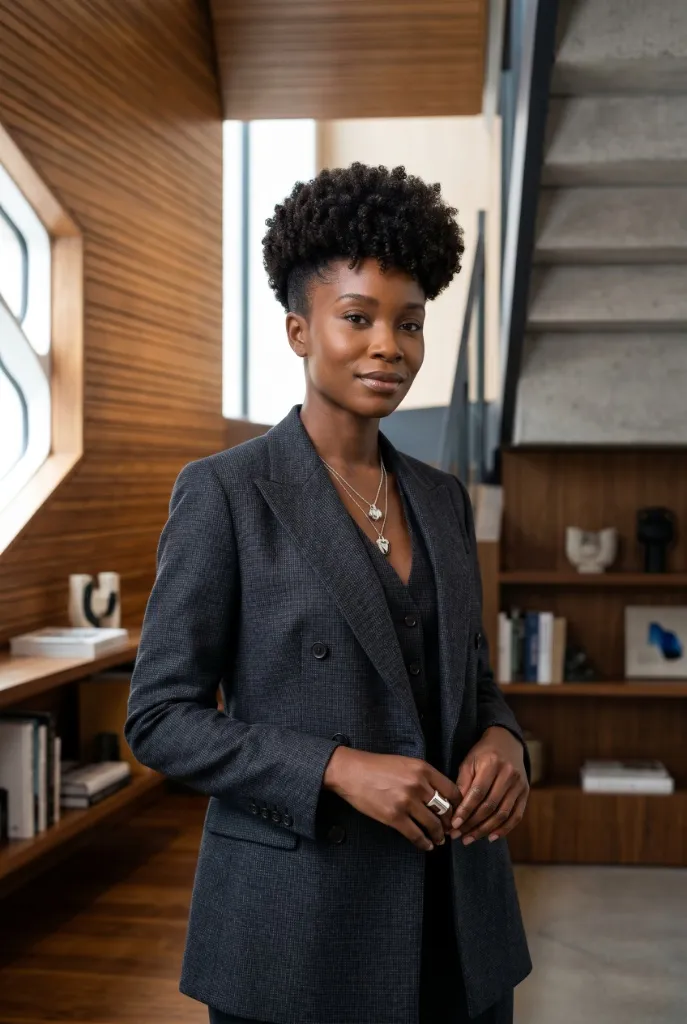
This is the cut for people who want short hair that commands a room. The technique combines scissor-over-comb at the sides and nape with dry-cutting through the top curls — two approaches that serve completely different functions but create a cohesive shape. The scissor-over-comb fade creates a clean, professional perimeter, while the dry-cut curls on top maintain their natural spring and volume. Built for type 3B to 4A curls with medium to high density, this cut uses the contrast between tight structure below and organic texture above to create visual interest. The deep midnight espresso color — no highlights, no dimension, just rich, uniform dark — reads as deliberate and sophisticated.
A curl cream on damp hair, diffused or air-dried, handles the top. The sides need nothing. Maintenance splits into two tracks: the fade needs attention every 3–4 weeks, while the curls on top can stretch to 6–8 weeks. The dual-technique approach is what makes this cut versatile enough for a boardroom and a rooftop dinner — the fade signals intention while the curls signal ease. Skip if your curl pattern is looser than 3B — you need tight enough coils to create vertical volume on top, or the proportions won’t balance against the close-cropped sides. If you’re also considering summer hairstyles for plus-size women, this crop’s strong vertical emphasis creates striking proportions on every frame. The power move.
11. The Cherry Cola Undone Bob
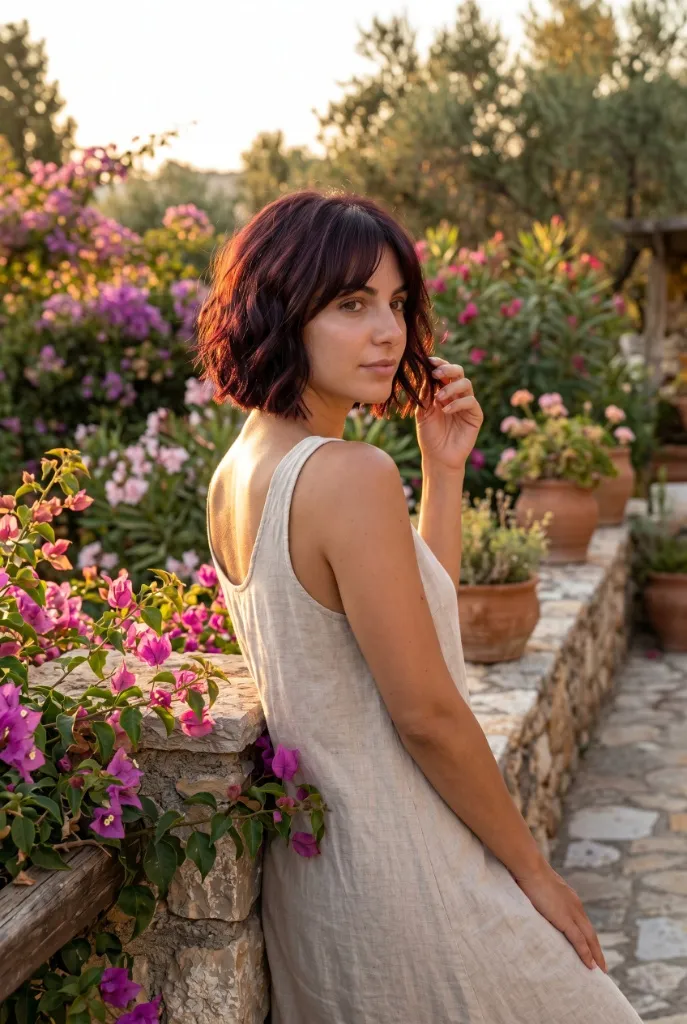
Everything about this bob is designed to look like you did nothing — which takes surprisingly specific technique to achieve. The cut uses internal thinning shears through the mid-lengths only, reducing weight between the surface and the interior while leaving the outermost layer intact and textured. This creates movement without visible layering, and it works best on medium density hair with a 2A to 2C wave pattern. The color is cherry cola — a deep, red-toned brown with burgundy pieces that catch copper in direct light — and the warmth intensifies at the ends where the hair is most porous. That golden-hour lighting isn’t hurting either, but the color genuinely shifts between indoor and outdoor light.
A salt spray or light curl cream on damp hair, scrunched and air-dried, is the entire routine. The ends are meant to look slightly unfinished — don’t smooth them. Trims every 6–7 weeks keep the internal thinning from growing out uneven, which can create a stringy look if neglected. Internal thinning is what keeps this bob from becoming a triangle on wavy hair — it removes bulk from inside the shape without sacrificing the visible texture on the surface. Not for fine hair — you don’t have enough interior density to thin, and the cut will look flat rather than undone. For more ideas in a similar vein, the collarbone-length haircuts for summer collection has some natural extensions of this approach if you want slightly more length. Finally, a bob that moves.
12. The Petal Pink Pixie Bob
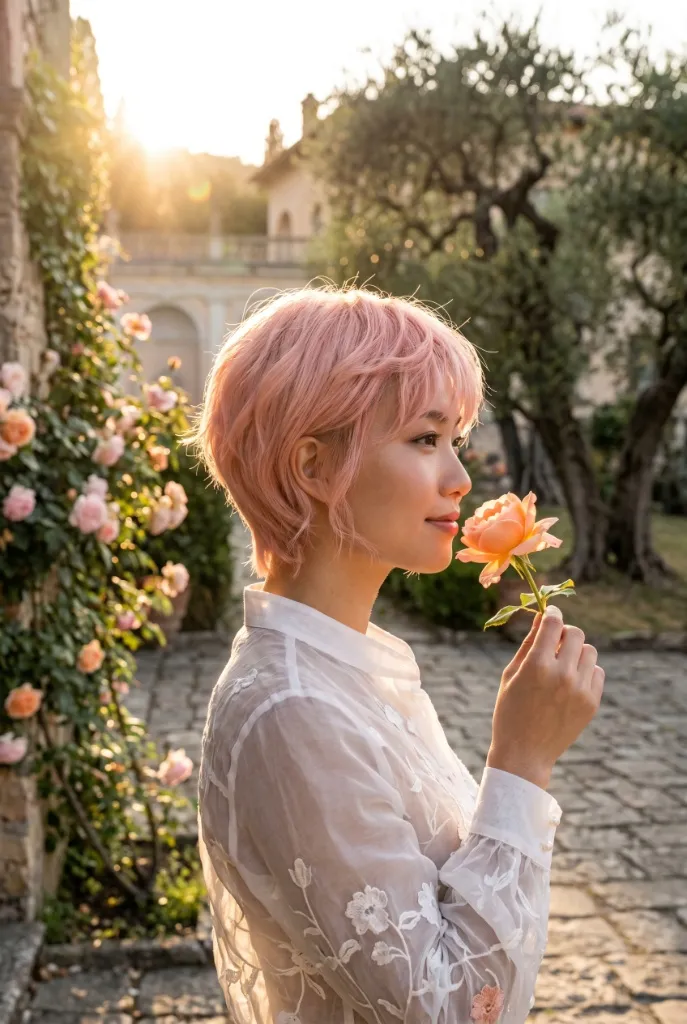
This sits in the sweet spot between a pixie and a bob — what some stylists call a “bixie” — and the technique is slide-cutting, where the shears glide down the hair shaft to create graduated lengths that blend without visible lines. The result is a shape that’s shorter at the nape, longer through the crown, and feathery at the temples, with no harsh transitions anywhere. It’s cut for fine to medium hair that’s straight to slightly wavy (1A to 2A), where the slide-cut graduation adds dimension that the hair texture alone can’t produce. The color is petal pink — softer and warmer than bubblegum, with almost a blush-rose quality that reads as romantic rather than punk. The honeyed undertone keeps it wearable.
Style with a dime of mousse on damp hair, then blow-dry with fingers or a small round brush for slight direction. Air-drying gives a flatter, more relaxed result — both are valid. Color maintenance is the biggest commitment: toner refreshes every 3–4 weeks, plus purple shampoo to keep the pink from yellowing. The slide-cutting technique is what makes the grow-out so forgiving — because there are no hard lines between lengths, the shape evolves gradually rather than becoming shapeless. Avoid if you have thick, coarse hair — the delicate, feathery effect relies on fine to medium strands, and thicker hair will overpower the softness entirely (my favorite kind of honest reality check). Whimsy, sharpened.
13. The Honey Feathered Beach Pixie
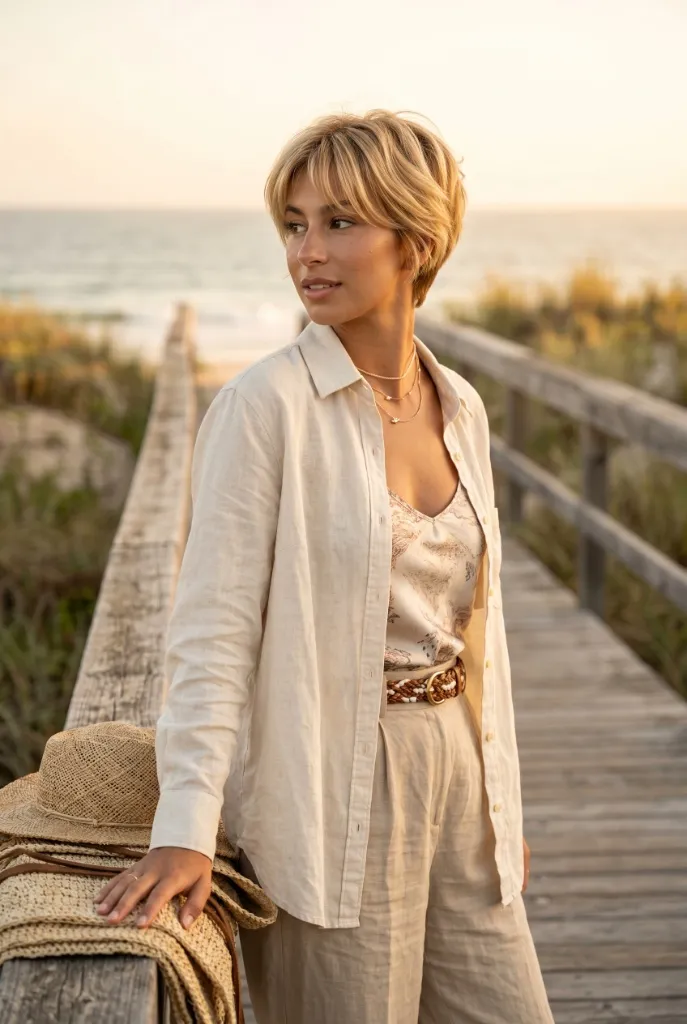
This pixie reads “I live somewhere warm and I don’t think about my hair much” — which is exactly the intention behind the point-cut feathering throughout every layer. Point-cutting at the tips creates wispy, tapered ends that catch the wind and move independently, and the layering is longer through the top and face frame while tapering short at the nape and ears. It works for fine to medium density straight to wavy hair (1B to 2A), where the feathering amplifies movement without needing curl or heavy product. The color is a buttercream blonde base with honey and caramel pieces — warm across the board, with no cool or ashy tones — and the depth variation keeps a short cut from looking flat or one-dimensional.
A texturizing paste or light salt spray on dry hair, tousled with fingers, and you’re done. If you’re looking for low-maintenance summer haircuts that grow out well, this is a strong candidate — the feathered layers grow into each other gracefully over 6–8 weeks between trims. Point-cut feathering removes weight gradually from each strand’s tip, creating a softness at the perimeter that blunt cutting simply cannot achieve. This is not for anyone who wants a sleek, polished finish — the entire personality of this cut is in its imprecision, and trying to smooth it defeats the purpose. Coastal in the bones.
14. The Midnight Sleek Ear-Tuck Bob

The precision here is almost surgical. This bob uses a blunt perimeter cut at the jawline combined with slight graduation — the hair is cut shorter at the back and longer at the front by about half an inch — which allows the side to tuck behind the ear without popping back out. The graduation is invisible from the front but does all the work. It’s built for straight, sleek hair (1A to 1C) with fine to medium density, where the hair’s natural weight helps it lie flat against the head. The color is midnight black — no warmth, no blue-black shimmer, just deep, true black — and on hair this smooth, the shine is architectural.
A smoothing serum on damp hair and a paddle brush blow-dry with tension create the finish. Or flat-iron the ends once for absolute precision. Trims every 6–7 weeks keep the jawline angle sharp. The slight graduation at the back is the mechanical key — it prevents the bob from bowing outward at the nape, which is the most common complaint with one-length bobs on straight hair. Skip if your hair has any wave or curl — this cut depends entirely on natural straightness, and fighting texture with daily heat isn’t worth the damage. For those exploring the broader mid-length haircuts for spring 2026, this sits right at the border between short and medium territory. Sharp. So sharp.
15. The Jet Geometric Inverted Bob
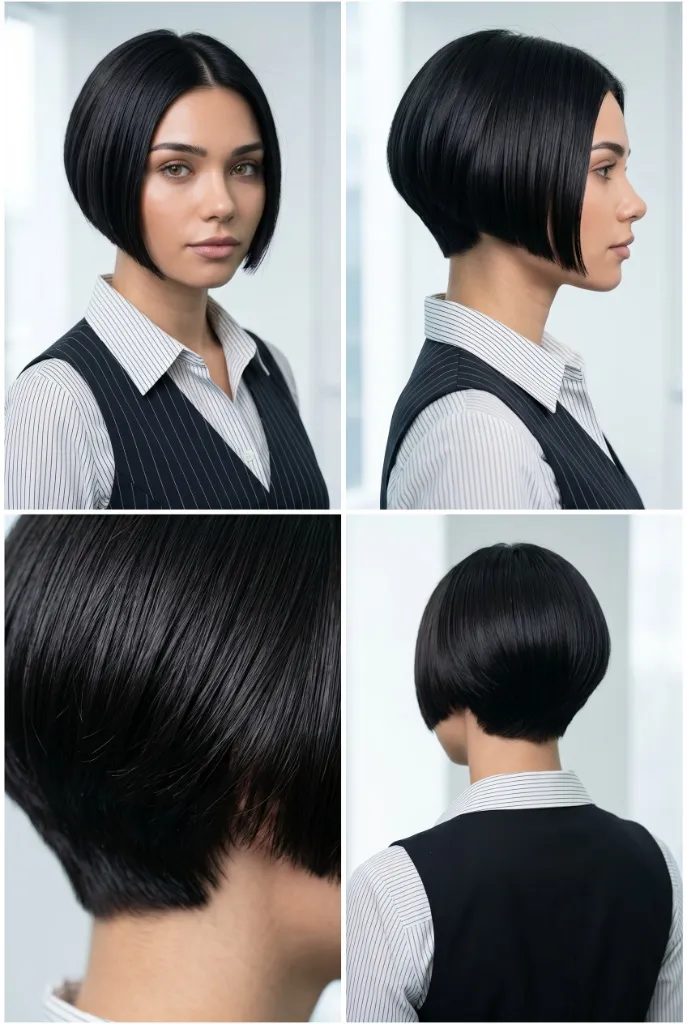
This four-angle breakdown shows exactly why an inverted bob requires a skilled hand. The technique is graduation cutting — the back is stacked with progressively shorter layers that create a rounded, voluminous shape at the occipital bone, while the front panels extend to chin length in a sharp diagonal line. The stacking at the back is what creates the signature shape: it pushes the hair outward into a rounded silhouette rather than hanging flat. This works on straight to barely wavy hair (1A to 2A) with medium to thick density — you need enough hair to create the stacked effect at the back without seeing scalp. The jet black color — uniform, cool-toned, zero dimension — turns this cut into pure geometry, where shape and line do all the communicating.
Blow-dry with a round brush, curling the back layers slightly under and smoothing the front panels straight. A smoothing serum is essential; frizz is the enemy of geometry. The trim schedule is strict: every 4–5 weeks, because the graduated back loses its stacked shape faster than any other cut style. Graduation cutting at the nape is what creates the volume and the rounded silhouette — each layer is cut slightly shorter than the one above, building outward rather than hanging down. This is absolutely not for wavy, curly, or fine hair — waves will distort the geometric lines, curls will create frizz at the stacked back, and fine hair won’t have enough density to build the shape. If short hairstyles for summer 2026 have a power suit equivalent, this is it. The definition is everything.